
Small islands do not sit on the periphery of global change
With my wife’s international job, I have recently moved to Barbados: a geographical vantage point in which the night sky becomes a unified canvas. Sitting just above the equator in the Eastern Caribbean, the island offers a rare special gift to an astrophotographer: the unique ability to capture the cosmic marvels of both the Northern and Southern celestial hemispheres from a single location. It is a place where separate worlds converge.
When looking at the sheer scale of the global challenges facing humanity, there is a frequent temptation to succumb to the illusion of insignificance: small, isolated geographical regions possess footprints too tiny to alter the trajectory of a massive, complicated world. Although this post is written from Barbados, its perspective belongs to all small island developing states across our planet—from the Caribbean to the Pacific and Indian Oceans. They are too often viewed through the lens of deficit, rather than potential.
But a deeper look into the infinite void reveals a profoundly different reality. To understand how true impact scales, one must look at the geometry of the universe itself.
The Geometry of Influence: From Micro to Macro
The universe does not move in rigid, linear blocks; it moves in spirals. The logarithmic spiral—the geometric footprint of the Golden Ratio—is found in everything from a microscopic shell on a Caribbean beach to a sprawling stellar system millions of light-years away.
Look closely at the West Indian Top Shell (Cittarium pica) found along the coast of Barbados.

Tracing its clean, stone whorls from the microscopic apex out to its wide aperture reveals a mathematically perfect growth ratio. This shell is an earthly anchor for a universal truth: a spiral always begins at a single, incredibly concentrated, tiny point. Yet, that initial, localized curvature dictates the structural physics of the entire outward expansion. Tracing this exact same cosmic spiral outward demonstrates how localized endeavours serve as the architectural blueprint for grand-scale realities.
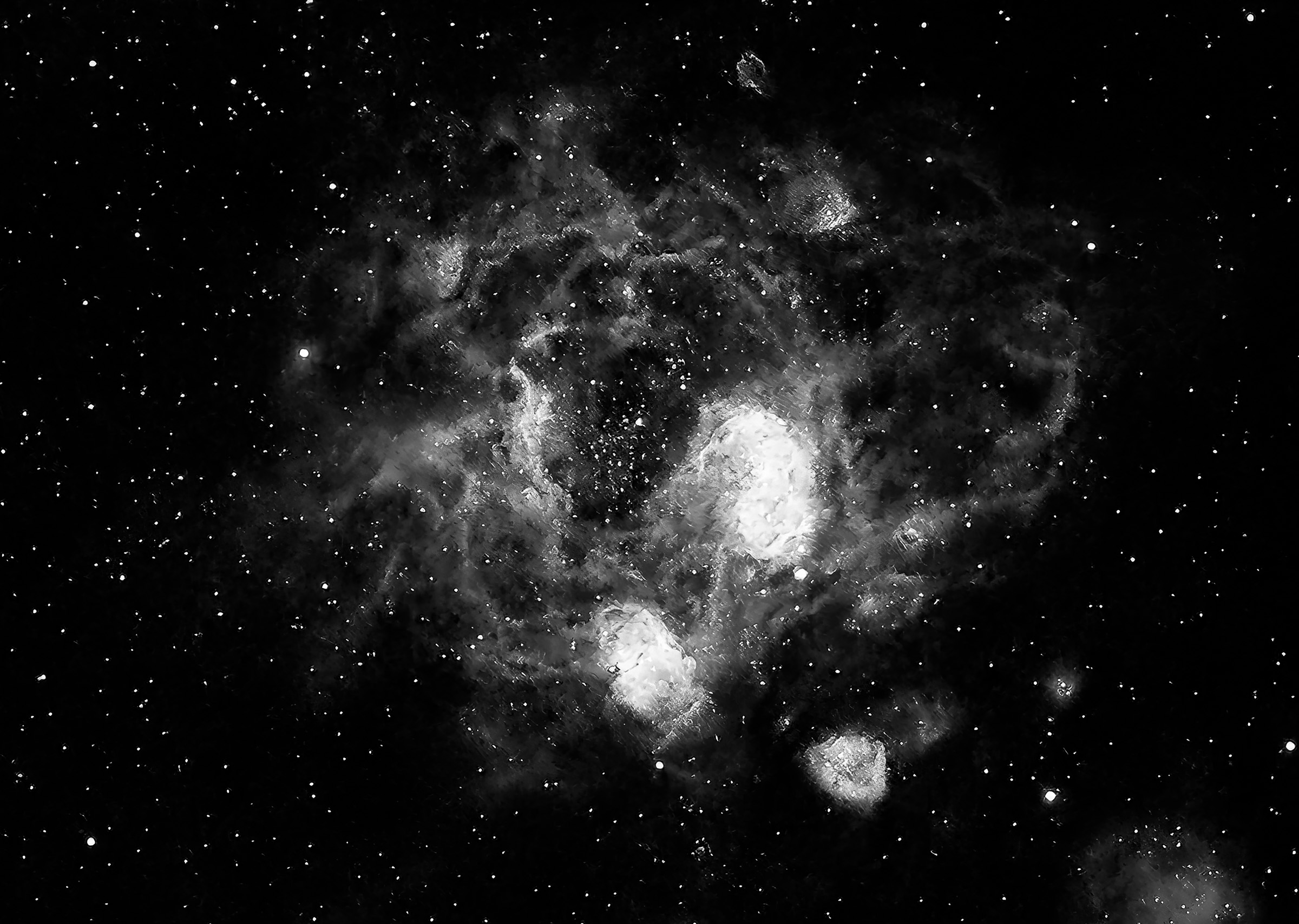
The Bean Nebula (NGC 1763): Captured from the southern sky. A compact, intense stellar nursery tucked within the Large Magellanic Cloud, proving that the most powerful cosmic catalysts often ignite within the smallest boundaries.
The Concept: The tiny, ultra-concentrated point where the spiral begins.
The Analogy: The Bean Nebula, tucked away in the Large Magellanic Cloud, is an intense, active stellar nursery. Though compact and isolated, its dense pockets of ionized gases are under intense energetic pressure. It is a reminder that a small, highly localized environment can become a fierce incubator for massive new creation. Small island states function precisely like these nurseries—serving as agile testing grounds where innovative solutions for climate resilience, sustainable economics, and social governance can be tightly refined away from the gridlock of larger nations.
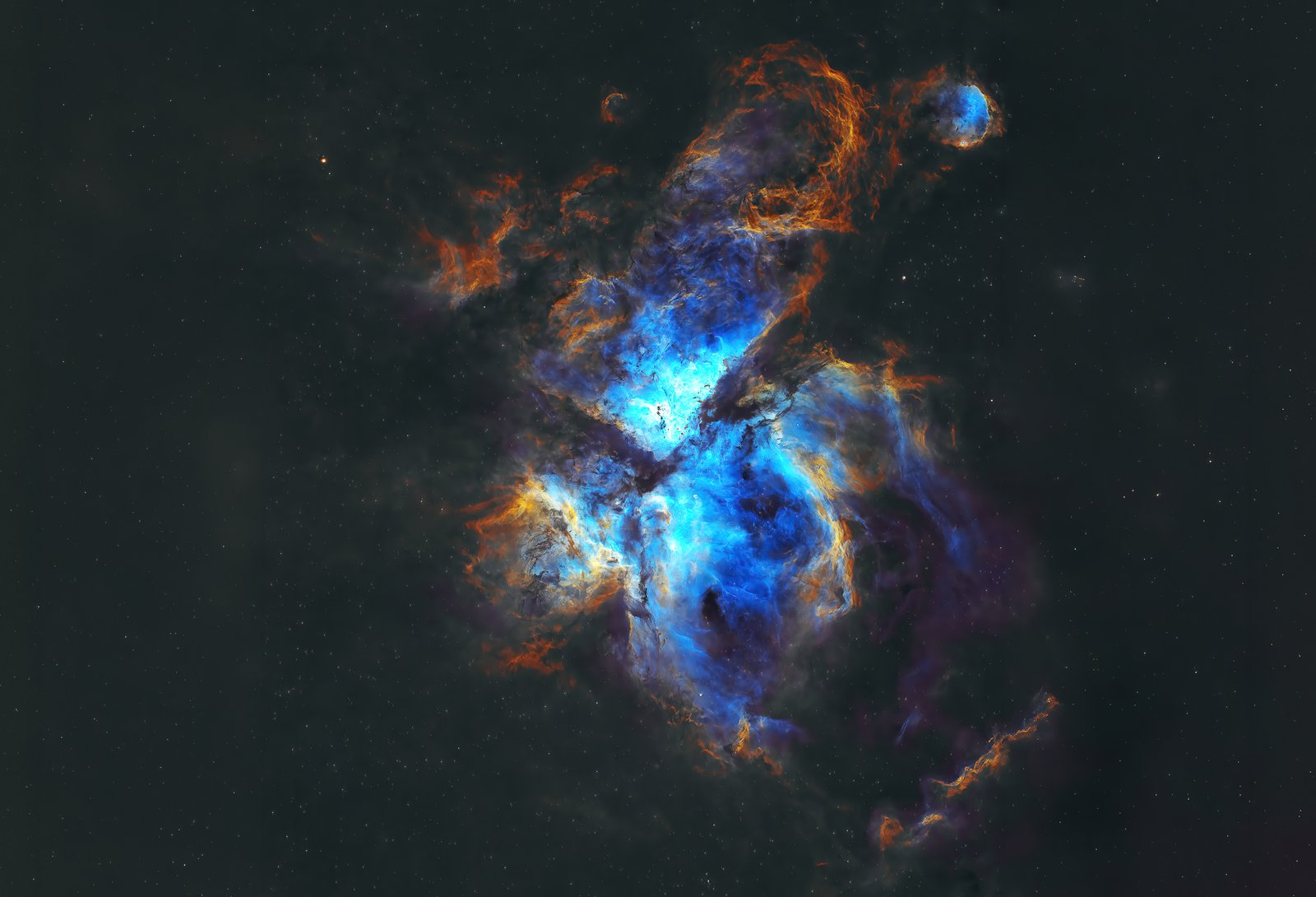
The Carina Nebula (NGC 3372): A cosmic demonstration of momentum, where energetic forces once confined to small stellar clusters have expanded into towering, light-years-wide walls of interstellar gas.
The Concept: The spiral widening, gathering immense force and material.
The Analogy: Moving outward along the curve, the spiral expands into the sweeping majesty of the Carina Nebula. Here, the energy from localized stellar clusters breaks out into massive, undulating walls of interstellar gas and dust. What began as microscopic, molecular interactions expands into a structure-spanning playground of cosmic evolution. This represents the phase where a successful model tested in a localized environment gains regional momentum, proving its viability on a grander stage.
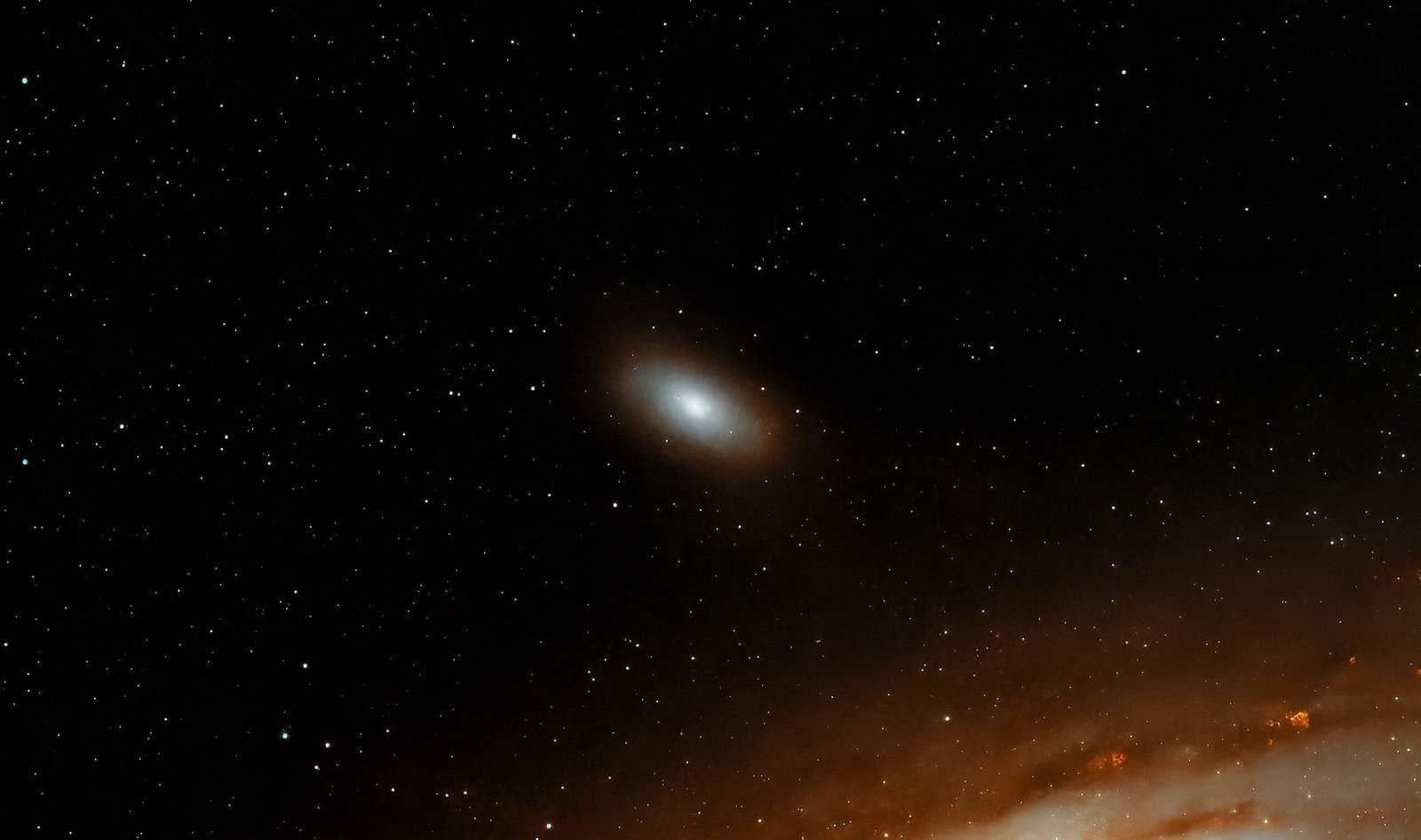
The Satellite Galaxy M110 (NGC 205): Mapped by Caroline Herschel on August 27, 1783. Orbiting its massive neighbour, Andromeda, this compact system holds its own independent gravitational weight—a cosmic reminder that being smaller does not mean being erased by a larger system.
The Concept: The small entity holding historical integrity against a dominant metropole.
The Analogy: Further out, the spiral encounters M110, a satellite galaxy orbiting the massive Andromeda Galaxy, famously mapped by Caroline Herschel on August 27, 1783. Historically and structurally, satellite galaxies are treated as mere passive backdrops, bound to the structural rules of their massive neighbours. Yet, astrophysics reveals that these compact systems possess their own profound gravitational integrity. They do not merely succumb; they dynamically interact with the macro-galaxy, altering its star-forming trajectory. M110 stands as a cosmic reminder that being smaller does not mean being consumed or erased by a larger system; it means holding an independent, inescapable weight that alters the macro-system from within.

The Cosmic Web (DESI 3D Map Contextual Graphic): Over 47 million galaxies cluster into delicate filaments, showing a macro-architecture entirely dependent on its individual, microscopic points of light.
The Concept: The ultimate macro-scale, where every individual point forms a global web.
The Analogy: Finally, the spiral uncoils into the grandest picture humanity has ever captured: the 3D map of the universe by the Dark Energy Spectroscopic Instrument (DESI). Mapping over 47 million galaxies, DESI reveals the “cosmic web”—a breathtaking network of filaments where individual galaxies look like mere pinpricks of light, yet cluster together to form the macro-architecture of reality. The universal structure literally cannot exist without the individual, clustered points. The small is inextricably woven into the grandest fabric of the whole.
The Crucible of History and the Spark of Agency
To speak of the light emerging from small island states without acknowledging the dark shadows of their history would be a failure of truth. The Caribbean islands, like many island nations globally, carry the awful, heavy legacy of colonialism and chattel slavery. For centuries, these geographies were subjected to a deliberate process of dehumanization—what Aimé Césaire in his seminal Discourse on Colonialism termed “thingification” (choseification). This ideological machinery systematically stripped the colonized of their agency, reducing active historical creators into passive commodities designed purely to feed the wealth of distant empires.
This was not a temporary disruption; it was a permanent institutional blueprint. Translating Césaire’s psychological and moral critique into macroeconomic reality, economists Lloyd Best and Kari Polanyi Levitt mapped how this legacy became entrenched through the Plantation Economy framework. They demonstrated that even after formal independence, islands remained legally and economically wired as a “hinterland of exploitation”. Under this model, the economic “plumbing” of the region is structured to automatically direct resources, validation, and decision-making power outward to a dominant foreign metropole, leaving the internal domestic space structurally starved.
Deconstructs the colonial "civilizing mission." Exposes how resource extraction strips local agency, systematically turning active historical creators into passive objects (choseification).
Maps out the systemic legacy of the Plantation Economy, proving that post-colonial economic "plumbing" remains wired to automatically siphon power outward to the foreign metropole.
Proves that genuine structural independence cannot be measured by foreign metrics or adjustments. Real development can only be built from the ground up, designed by and for the local majority.
The Cosmic Harmony: Modern international interventions must completely abandon paternalistic top-down implementation, shifting entirely to the pure amplification of native island sparks while preserving full local ownership.
Yet, the true marvel of these islands is that they are not defined by this extraction; they are defined by their refusal of it. As economist Clive Thomas details in The Poor and the Powerless, the history of the Caribbean majority—the slaves, indentured labourers, and peasants—is fundamentally a record of relentless, counter-gravitational resistance against external subjugation. Thomas provides the definitive democratic mandate: genuine independence cannot be measured by foreign investment metrics, nor can it be handed down by global elites. It is “indissolubly linked” to social and political experimentation generated directly by the people. Development by the poor, for the poor is not merely an alternative; it is an absolute necessity for breaking structural dependency.
This intellectual lineage dictates a fierce boundary for modern international organizations and global climate funds. When external entities arrive with pre-packaged development agendas under the guise of “saving” or “improving” these islands, they are practicing a modernized variation of the old colonial “civilizing mission.” Trying to “do things for” an island without its absolute authorship repeats paternalistic patterns, reducing islanders once again from active historical agents back to passive recipients of foreign policy.
True external alliance requires a complete shift from intervention to amplification. The sparks of systemic change, sustainable resource management, and resilience are already being instigated by the islands themselves. Global organizations must act strictly as lenses, platforming local brilliance, while stepping back completely so that full local ownership is maintained. As Césaire famously declared when asserting that his people must be the absolute masters of their own destiny: external forces must serve as amplifiers of native action, never its directors.
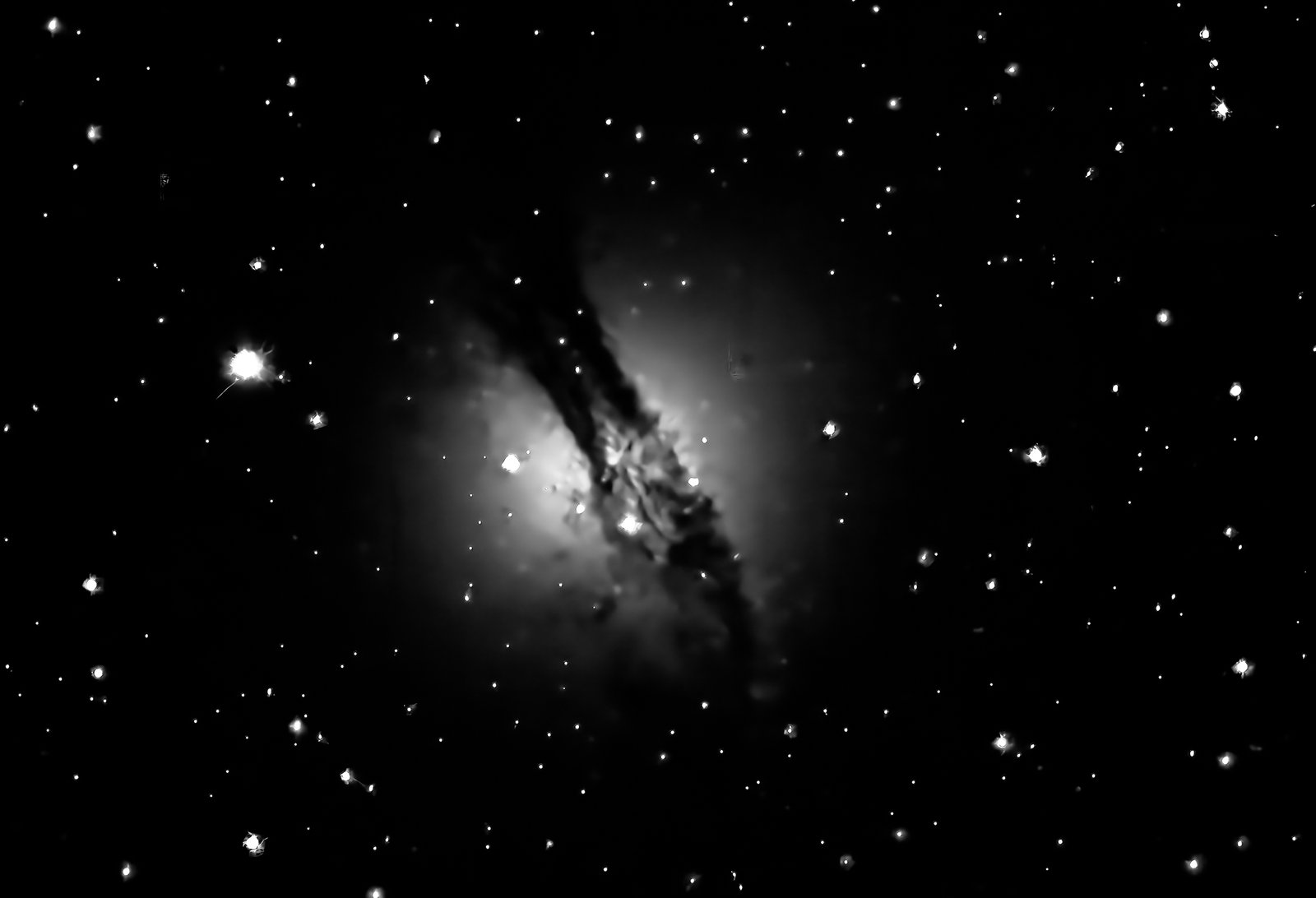
Centaurus A (NGC 5128): A massive galaxy shaped by a historic cosmic collision; its signature belt of dark dust and explosive star formation serves as a profound visual symbol of structural resilience and native transformation.
The Concept: Radical structural transformation triggered from within a historical collision.
The Analogy: To find a perfect cosmic mirror for this historical crucible within our shared sky, we look to Centaurus A. This massive galaxy is the striking result of a violent, monumental collision—having entirely consumed a smaller spiral galaxy hundreds of millions of years ago. The profound trauma of that historic rupture did not obliterate the system. Instead, it triggered an explosive, brilliant wave of star formation and left a dramatic, unmistakable belt of dark dust slicing straight through its incandescent centre. Centaurus A stands as a stunning testament to structural resilience: a system that absorbed the immense disruption of an outside collision and transformed it into a self-sustaining engine of intense new light and structural beauty.
Shining Global Lights
This brings us back to the profound essence of our cosmic map. Small island states are not isolated dots on a map to be managed from afar; they are the vital fountainheads where the initial, crucial curvature of the spiral takes shape.
Shining Global Lights
★ ✧ ★When a spark of innovation, resilience, or sustainable coexistence is successfully ignited on a small island, it does not remain contained. Because of the interconnected, spiral nature of our world, these concentrated breakthroughs act as Shining Global Lights.
Just as the explosive starburst centre of Centaurus A blazes across the dark void, or a satellite galaxy like M110 holds its own immutable gravity against Andromeda, the solutions refined within these vibrant island sanctuaries possess a radiant, scalable power. They offer empirical proof to the rest of the world of what is possible.
By looking at the cosmos from the equator, we see that the micro and the macro are one and the same. Small islands do not sit on the periphery of global change—they are the very places where the light is generated to illuminate the dark, terrible problems facing our shared cosmic home.