
Cosmic Structures in the Credits.....
The cinematic adaptation of Andy Weir’s Project Hail Mary stands as a compelling testament to hard science fiction, grounding its narrative of human survival in the rigorous laws of physics and biology. The second time I watched Project Hail Mary, I paid attention to the credits: I was dumbstruck when I saw an image of the Keyhole Nebula (within the Carina Nebula), and I shouted, “Oh, I’ve got an image of that!”
SPOILER ALERT: If you haven’t yet seen the movie, just go to the images here. Otherwise, read on…
Doing a bit of research, I found that Rod Prazeres had captured images of five monumental cosmic structures that were included as background to the credits: the Carina Nebula, the Rosette Nebula, the Vela Supernova Remnant, the Fighting Dragons of Ara, and the Running Chicken Nebula.
For those of us who systematically document the night sky across both the Northern and Southern Hemispheres, as I do on astroanderson.com, these objects are not digital backdrops: they are physical, enduring realities. Examining these five specific targets allows us to bridge the narrative arc of the film with genuine astrophysical data and the broader philosophical questions of our place in the cosmos. With no disrespect to Rod Prazeres, whose images are way better than mine, here are my own takes on the five.
1. The Carina Nebula (NGC 3372)
- The Astrophysics: Spanning more than 300 light-years across the southern constellation of Carina, NGC 3372 is one of the largest diffuse emission nebulae in our galaxy. Situated roughly 8,500 light-years away, it acts as a colossal stellar engine, powered by highly luminous, massive stars. Among them is Eta Carinae, a volatile hypergiant system emitting millions of times the luminosity of our Sun, balanced precariously on the thermodynamic edge of a supernova event.
- The Philosophical Intersection: The Carina Nebula represents the violent, unyielding genesis of matter. In Project Hail Mary, the existential threat stems from the ‘Astrophage’, an organism siphoning the energy of our host star, threatening a planetary freeze. Carina serves as a stark reminder of the sheer scale of stellar mechanisms. It highlights the philosophical truth that life is entirely subservient to the thermodynamic outputs of stars. We are fundamentally the collateral byproduct of these massive cosmic furnaces, which forge the heavy elements necessary for biological complexity.
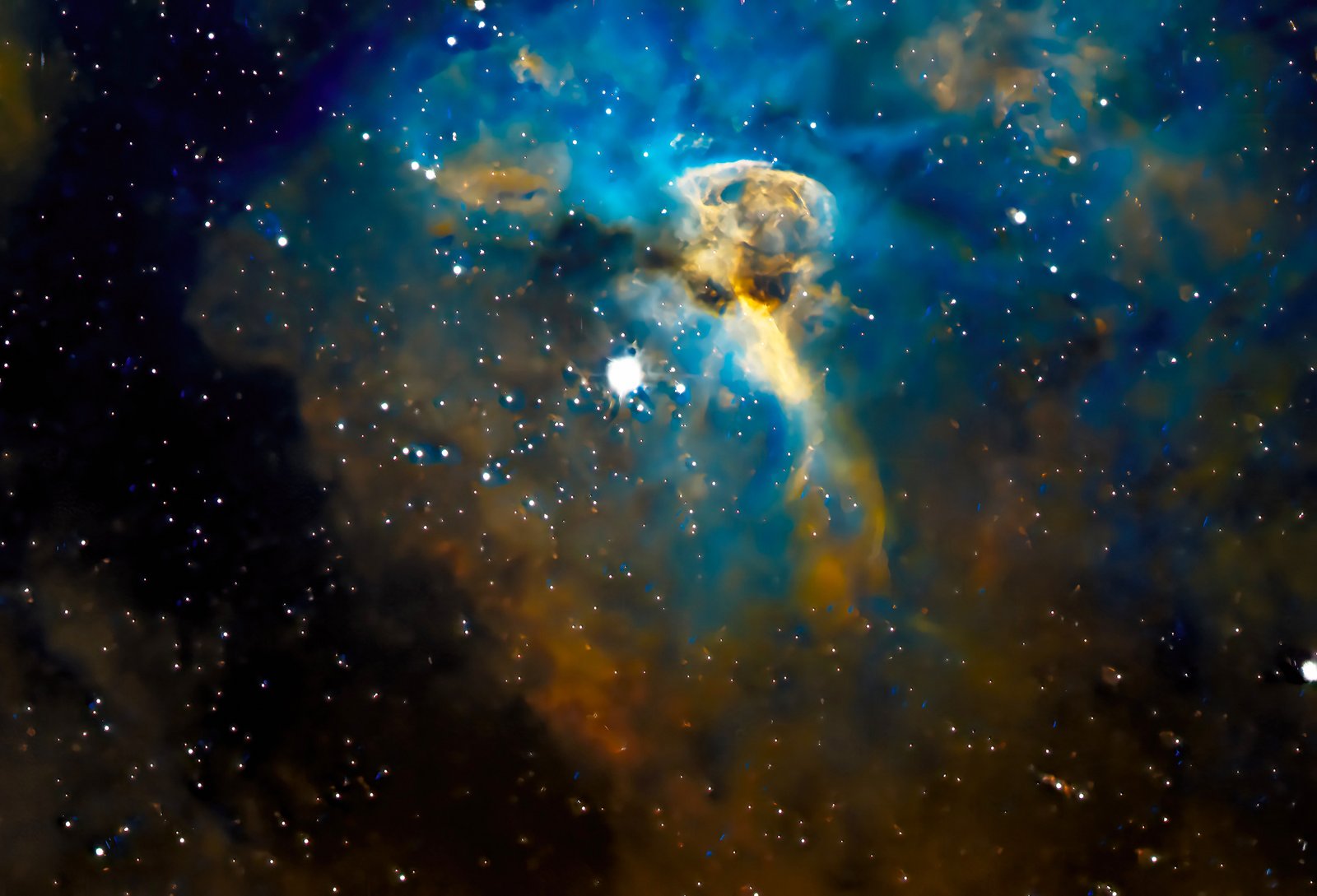
The Keyhole Nebula: a small, dark cloud of cold molecules, dust, and glowing gas within the much larger Carina Nebula. Located roughly 7,500 to 8,000 light-years away, it gets its iconic name from the glowing, keyhole-shaped outline sculpted by the intense stellar winds of the massive star system Eta Carinae.
2. The Rosette Nebula (NGC 2237)
- The Astrophysics: Located 5,200 light-years from Earth in the Monoceros constellation, the Rosette Nebula is a vast molecular cloud shaped by structural feedback. The central open cluster of young, hot OB stars (NGC 2244) generates powerful stellar winds and intense ultraviolet radiation. This output has hollowed out the nebula’s core, compressing the surrounding interstellar gas and dust to catalyse ongoing star formation along its perimeter.
- The Philosophical Intersection: The Rosette Nebula illustrates order emerging from chaotic dynamics—a structural symmetry maintained by opposing forces. This mirrors the core ecological crisis of Weir’s narrative: the delicate, mathematical equilibrium required to maintain a biosphere. Just as the central star cluster sculpts the surrounding gas without entirely dispersing it, an intelligent species must navigate and balance its energy consumption within its solar system. The Rosette stands as a symbol of cosmic homeostasis.
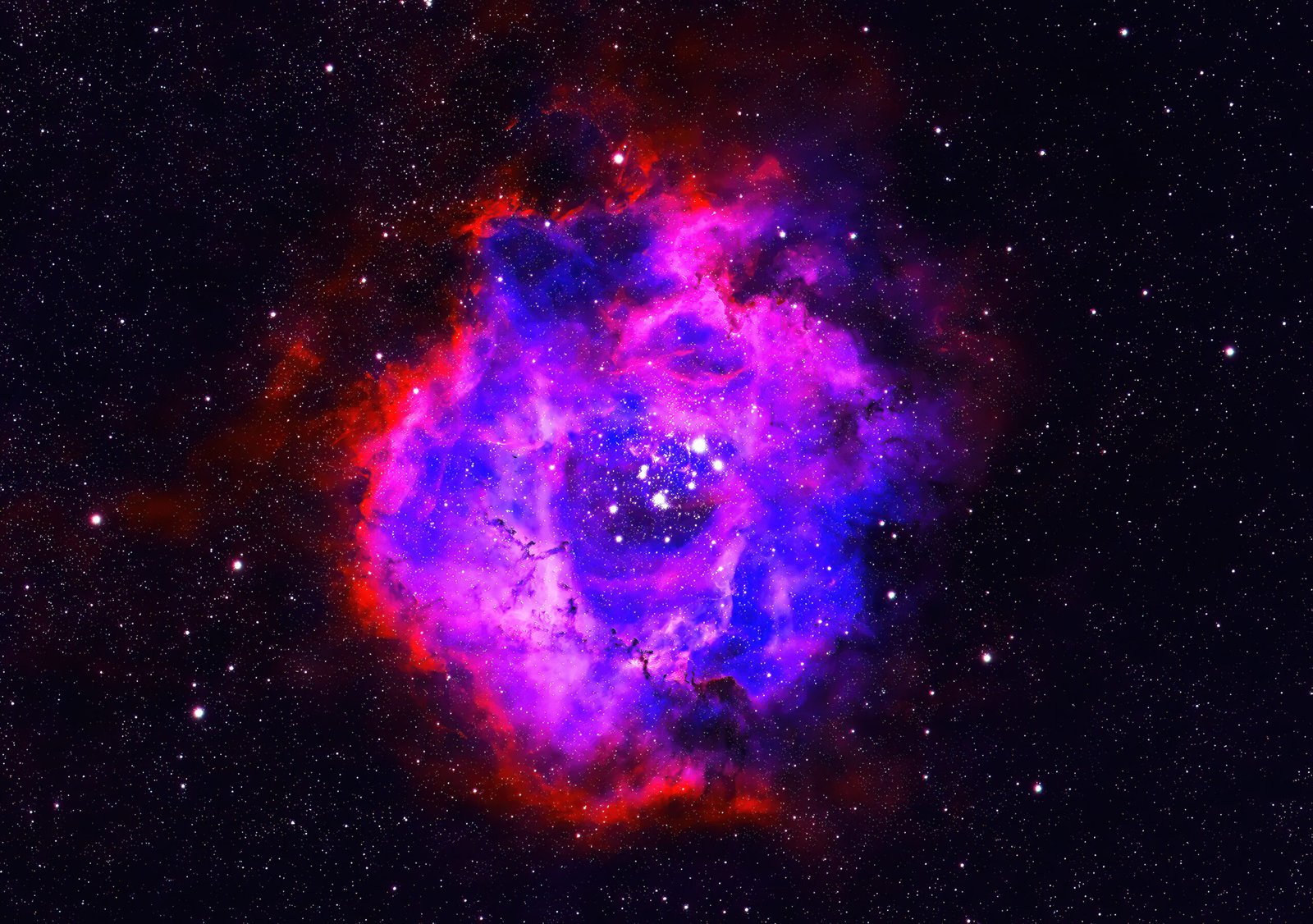
The Rosette Nebula: NGC 2237 is a huge star-forming region spanning 100 lightyears across and located 5,000 lightyears away. At the centre of the nebula is NGC 2244, a group of stars that form a gravitationally bound open star cluster thought to be about 4 million years old. These stars emit streams of charged particles known as stellar winds, carving out the gas and dust at the nebula’s centre and giving it the Rosette nickname.
3. The Vela Supernova Remnant
- The Astrophysics: Approximately 11,000 years ago, a massive star in the Southern sky collapsed, culminating in a violent supernova explosion. Today, the Vela Remnant exists as a sprawling, expanding web of shocked gas filaments colliding with the interstellar medium at hyper-velocities. At its core resides the Vela Pulsar, a highly magnetized, rapidly rotating neutron star that remains as the hyper-dense corpse of the original progenitor.
- The Philosophical Intersection: If Carina is the architecture of cosmic birth, Vela is a monument to stellar mortality. The plot of Project Hail Mary is a calculated race against a ticking clock to prevent Earth from becoming an ecological graveyard. Vela provides the empirical aftermath of stellar death. Philosophically, however, it reframes destruction as a prerequisite for progression. The shockwaves that tear through the interstellar medium enrich space with heavy elements, seeding the gas clouds that will form future solar systems. It reminds us that on a cosmic timeline, extinction and creation are inextricably linked.
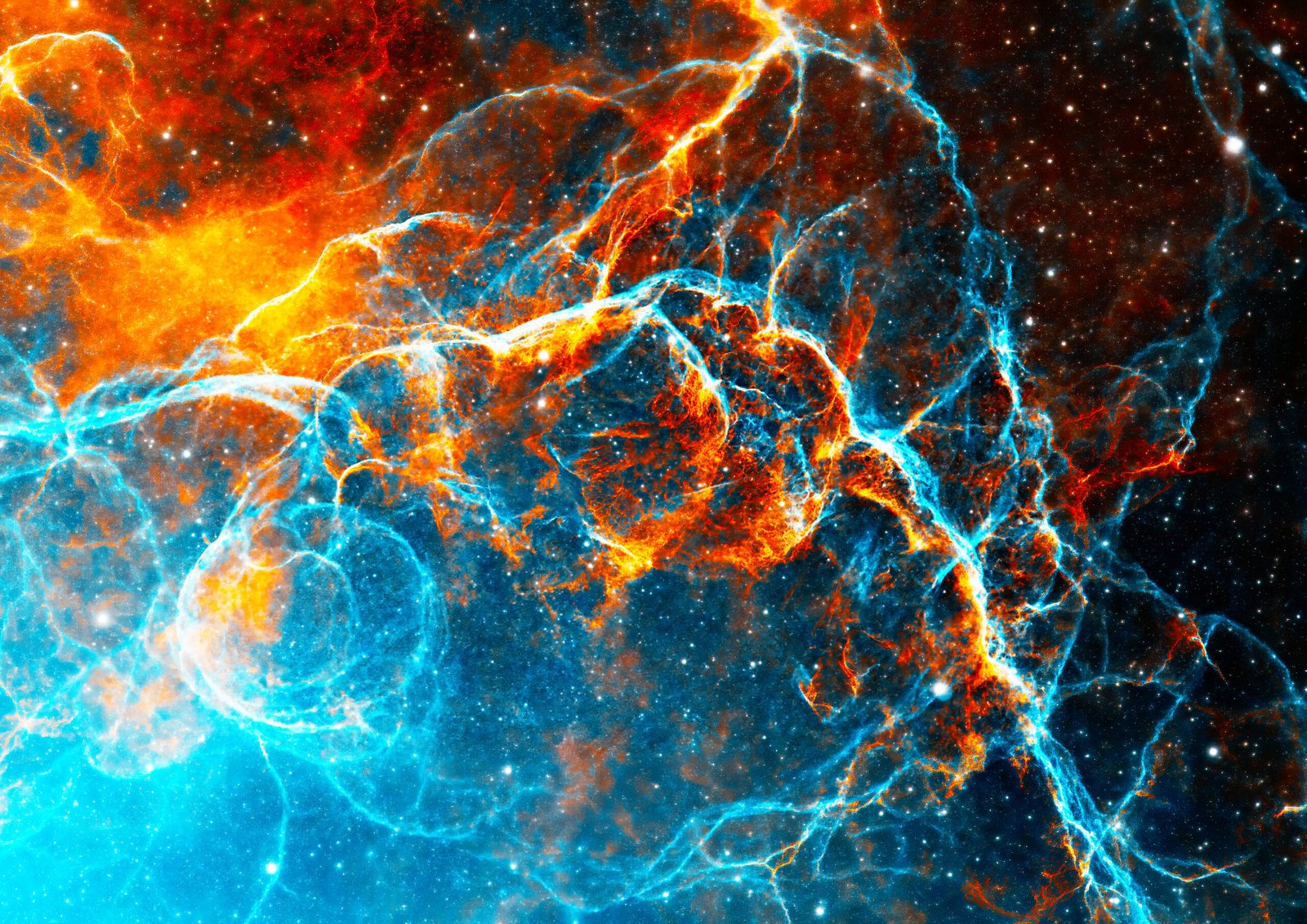
The Vela Supernova Remnant: While the initial blast wave from the core-collapse explosion roughly 11,000 years ago moved at millions of kilometres per hour (up to 10% the speed of light), it has slowed down significantly over the millennia to between 250,000 to 500,000 km/h. As the debris expands outward into interstellar space, it continuously ploughs into the surrounding gas and dust, creating a massive, glowing shell of shocked filaments that now spans nearly 100 light-years across.
4. The Fighting Dragons of Ara (NGC 6188)
- The Astrophysics: Found 4,000 light-years away in the southern constellation of Ara, this emission nebula features dramatic, dark dust lanes contrasted against glowing ionized gas. The dark, column-like structures are dense molecular clouds being systematically eroded and sculpted by the intense ultraviolet radiation and stellar winds of the young, massive stars embedded within the open cluster NGC 6193.
- The Philosophical Intersection: Human perception projects the imagery of mythical beasts locked in conflict onto these dust pillars; in reality, the structures represent an indifferent, elemental struggle between radiation pressure and gravitational collapse. This dynamic serves as an elegant metaphor for the relationship in the movie between Ryland Grace and Rocky. Divided by entirely different evolutionary, biological, and planetary histories, they must look past superficial, alien differences to cooperate against a common, non-sentient biological threat. The “dragons” remind us that cooperation is often the most logical adaptation for survival against indifferent universal forces.
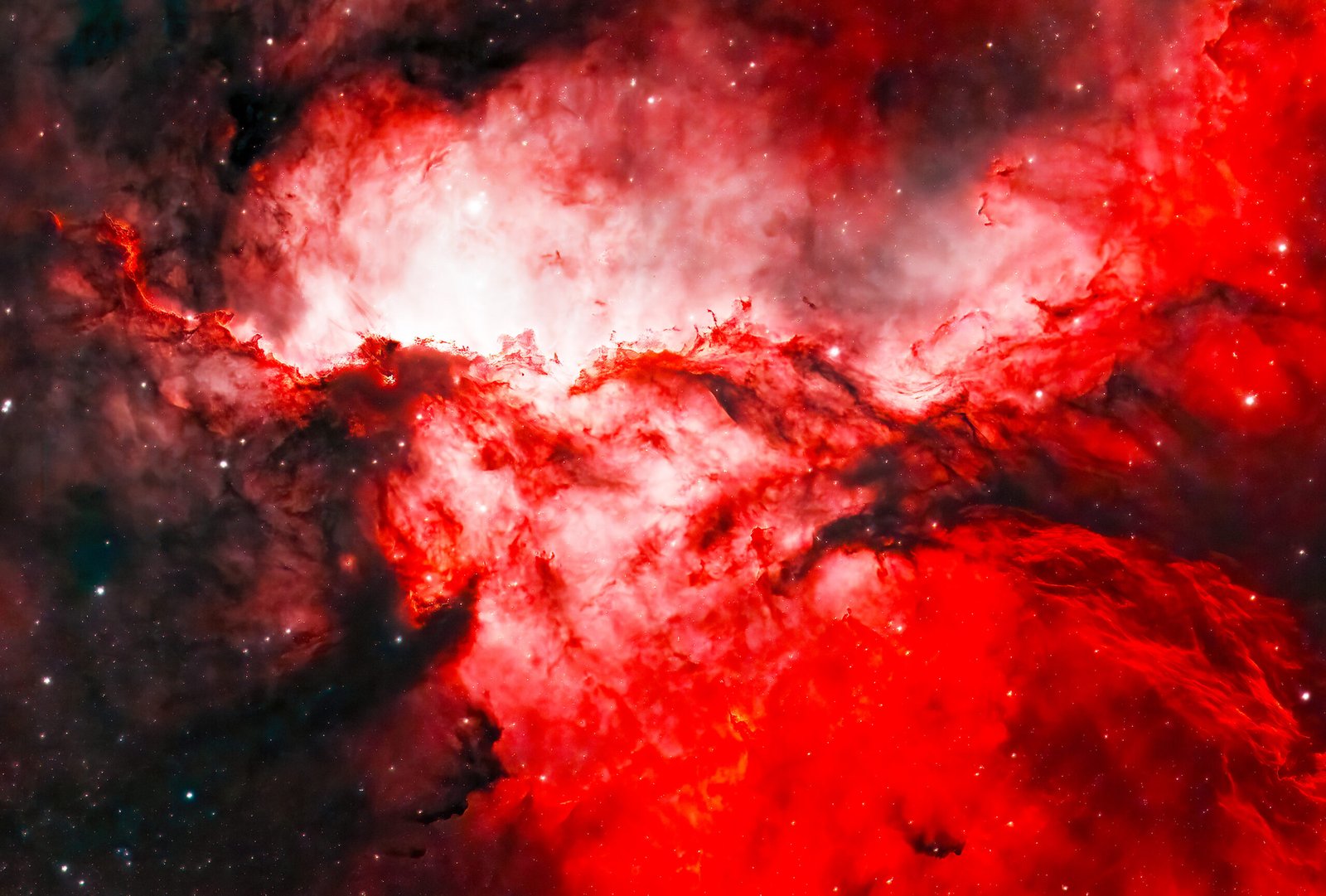
Fighting Dragons of Ara: NGC 6188 is located 4,000 lightyears from Earth. The “dragons” are made up of thick, dark dust clouds that appear black, but also lighter dust clouds that glow in red due to ionized hydrogen, caused by the energetic outflows from hot, young stars.
5. The Running Chicken Nebula (IC 2944)
- The Astrophysics: IC 2944 is an active star-forming region located 6,500 light-years away in the constellation Centaurus. It is scientifically distinct for its inclusion of Thackeray’s Globules – small, opaque, and highly condensed cocoons of interstellar dust. These dark globules are currently subjected to intense erosion from the high-energy radiation of nearby newborn stars, fracturing their structures before they can successfully collapse into low-mass stars.
- The Philosophical Intersection: Despite its unscientific common name, IC 2944 represents the fragile, stubborn isolation of matter attempting to coalesce. Thackeray’s Globules are isolated micro-environments fighting a losing thermodynamic battle against a hostile, energetic surroundings. This encapsulates the narrative core of Project Hail Mary: life is a statistically improbable, highly isolated anomaly fighting against the relentless entropy of the universe. The nebula illustrates that whether at the microscopic, human, or stellar scale, the struggle to exist in a silent vacuum is a universal constant.
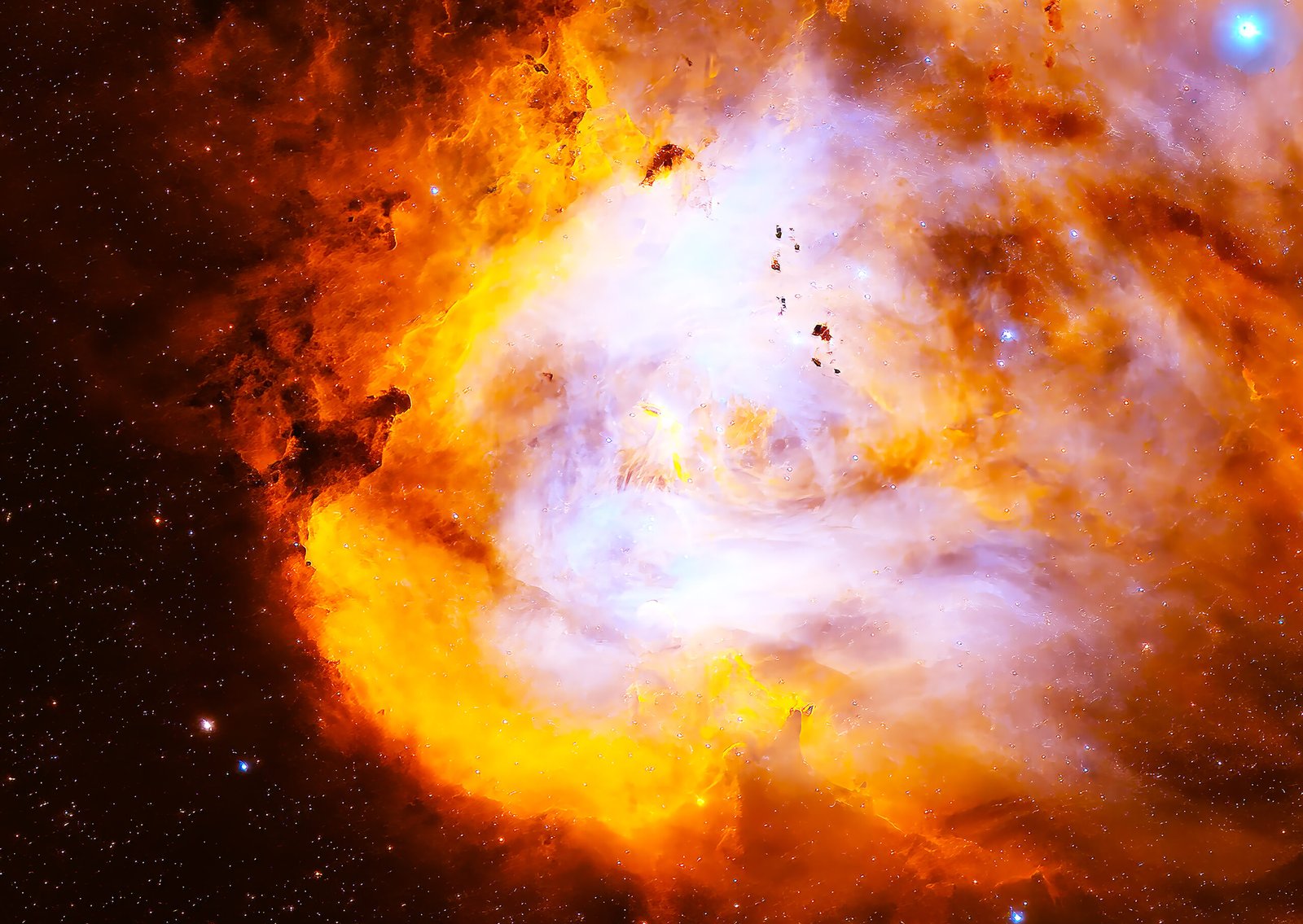
The Running Chicken Nebula: IC 2944 is an active star-forming region located 6,500 light-years away in the constellation Centaurus. It is scientifically distinct for its inclusion of Thackeray’s Globules – small, opaque, and highly condensed cocoons of interstellar dust. In this close-up image, one can almost imagine an astronaut climbing up on the left.
Conclusion: The Universe Observes Itself
When the credits roll on Project Hail Mary, the juxtaposition of human cinematic achievement against Rod Prazeres‘ authentic deep-space photography delivers a realization: the cosmos is not merely an aesthetic backdrop for science fiction – it is our origin point and our ultimate destination.
Whether we analyse these structures through a telescope or view them represented on a cinema screen, the objective remains the same: we are a collection of conscious, carbon-based entities using empirical science to understand the void. In doing so, we fulfil the profound philosophical truth that we are, quite literally, a way for the cosmos to know itself.