
The Ghostly Archivists: How Ancient Photons Map Our Universe…..
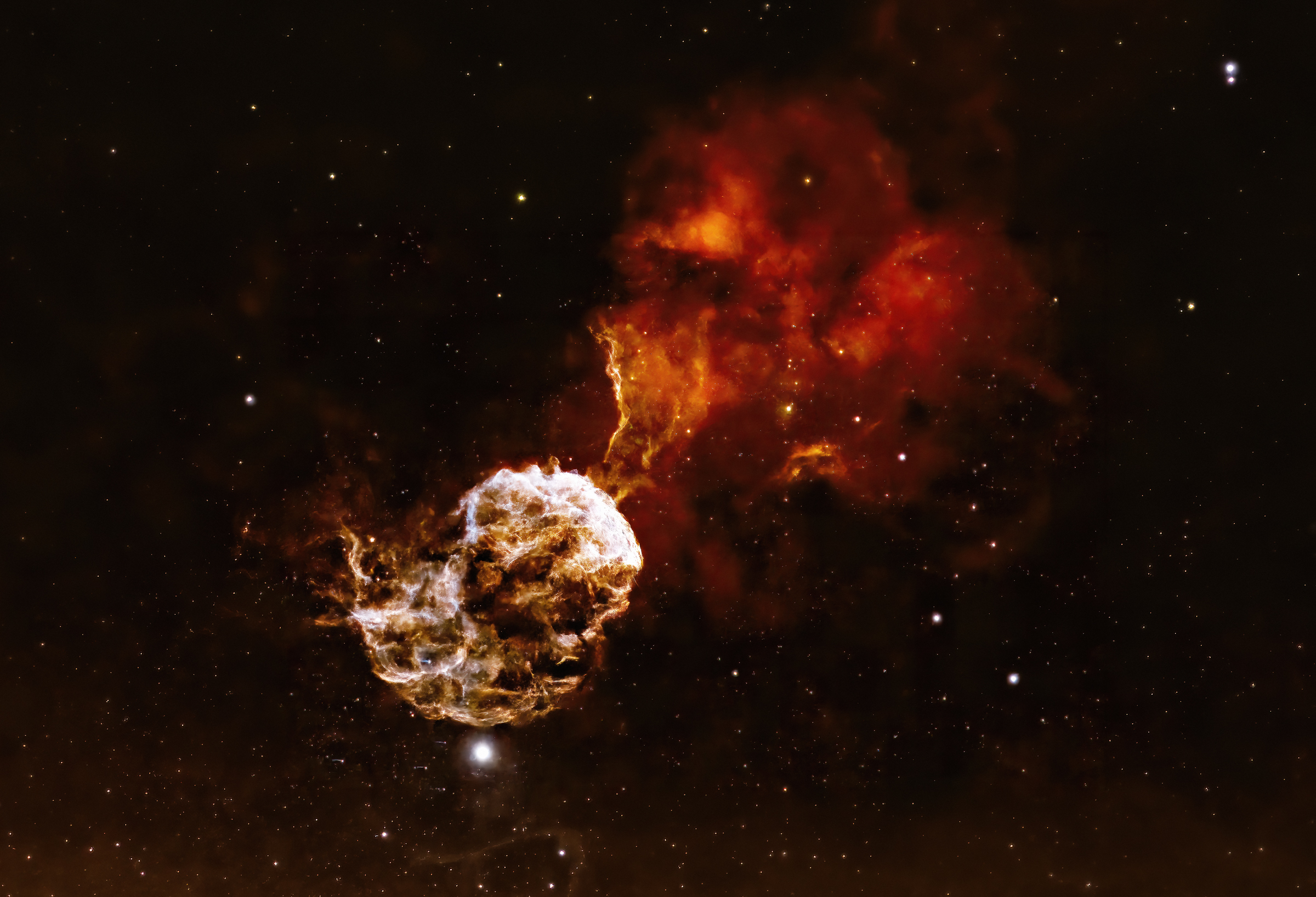
Photons are the ultimate cosmic messengers, connecting human curiosity to the deepest corners of the universe. Every image on astroanderson.com – from the northern Jellyfish Nebula
to the southern Trifid Nebula
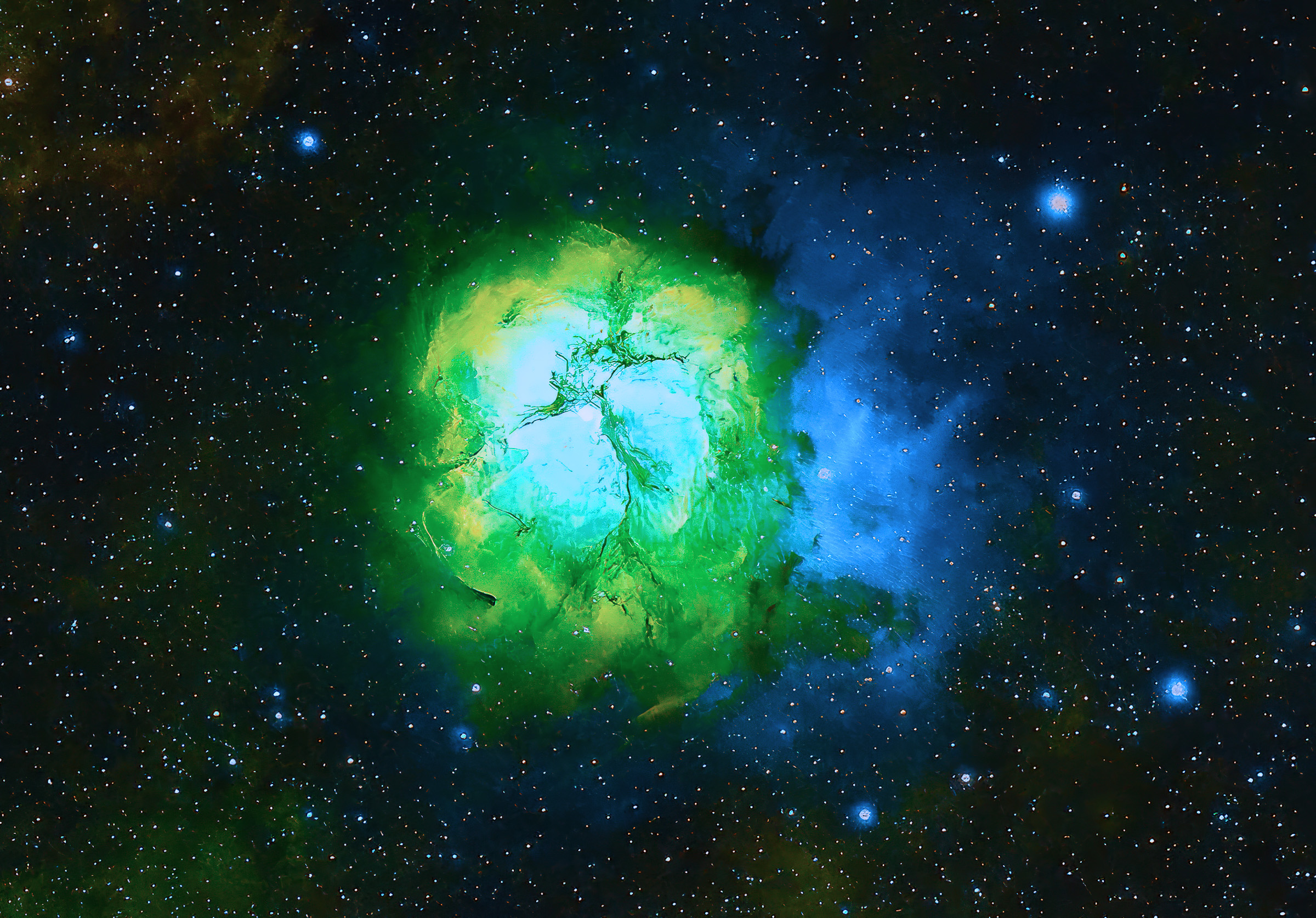
is a canvas painted by particles that have travelled across unimaginable voids of space and time.
The most distant object included in astroanderson.com, the Silver Sliver Galaxy (NGC 891), stands as a testament to this journey. The light captured in that single, needle-thin streak of cosmic dust travelled a staggering 30 million light-years just to reach the camera sensor.
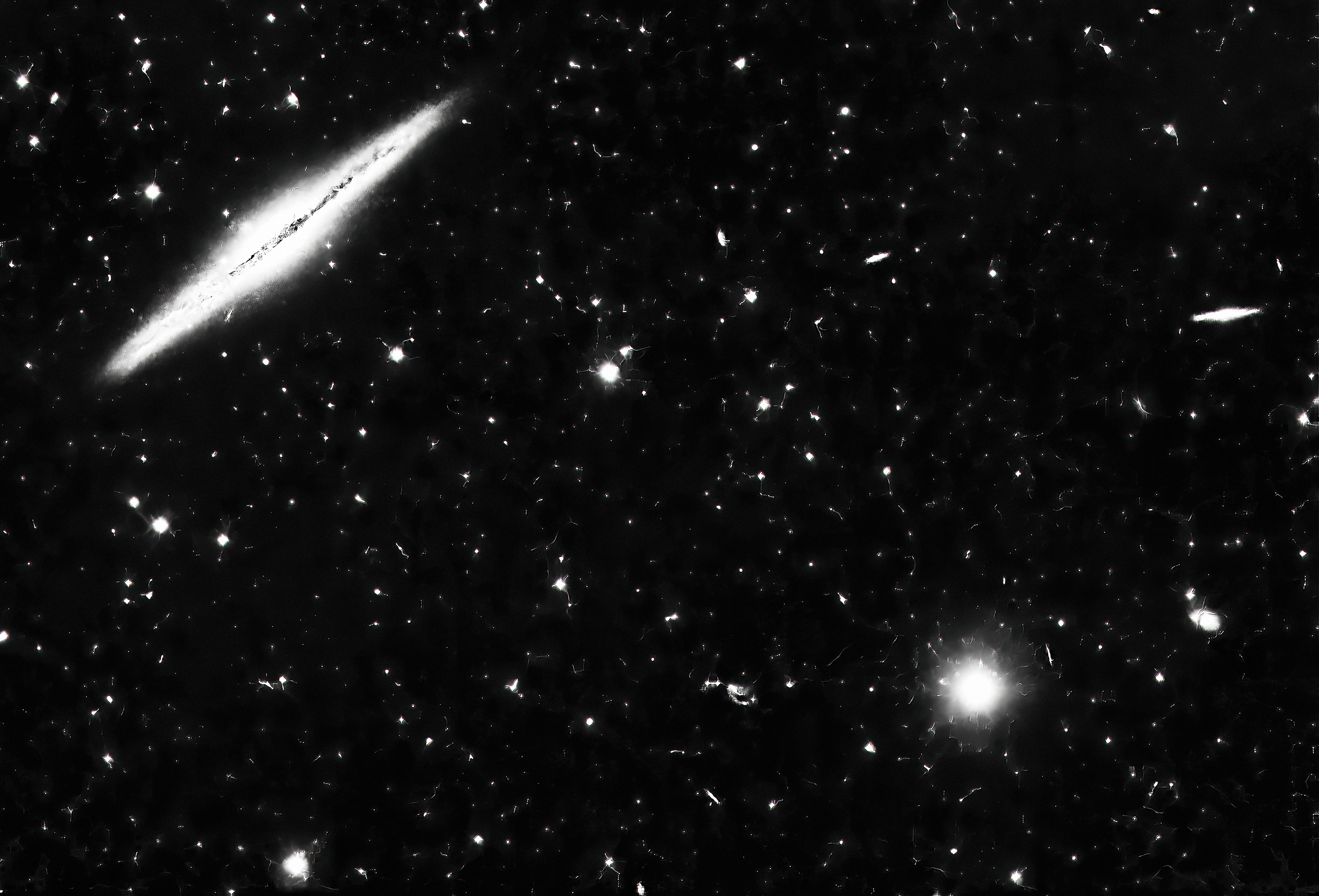
Here is the scientific and philosophical reality of the light captured in astrophotography.
The Genesis of Light: How a Photon is Born
To understand the light of the Silver Sliver Galaxy, we must first look at how a photon is created. At the atomic level, photons are the currency of energy stabilization.
- Atomic Excitation: Inside cosmic furnaces, stars, and glowing nebulae, atoms are constantly bombarded with thermal or radiative energy. This energy kicks an electron out of its stable “ground state” into a higher, unstable energy orbit.
- The Quantum Leap: The electron cannot remain in this excited state for long. When it drops back down to its lower, preferred orbit, it must instantly shed that excess energy.
- Birth of the Photon: That discarded package of energy is released into the void as a single photon. The exact distance of the electron’s drop dictates the photon’s wavelength – determining whether it becomes invisible infrared warmth, a sliver of visible optical colour, or a high-energy ultraviolet ray.
The Relativistic Paradox: The Non-Existence of Time and Space
When we bridge the physics of light with Albert Einstein’s theory of special relativity, we collide with a staggering philosophical conundrum. Because photons possess no rest mass, they travel at the absolute speed limit of cosmology (c). At this velocity, the fabric of spacetime distorts to its absolute limit.
For the photon, neither time nor space exists.
This reality introduces two profound philosophical crises that challenge how humans perceive existence.
THE TWO CONTRADICTORY REALITIES
[ Human Perspective ] ———————————————>
Distance: 30 Million Light-Years | Time Elapsed: 30 Million Years
[ Photon Perspective ] -> (Instantaneous Collapse)
Distance: 0 Meters | Time Elapsed: 0 Seconds
- The Conundrum of Time: Imaging the Dead Past in the Present
From our terrestrial vantage point, space is a vast historical archive. The photons falling onto the camera sensor to image the Silver Sliver Galaxy left their home roughly 30 million years ago. When those particles were born, early primates were just beginning to evolve on Earth. The astrophotograph is, by our definitions, an image of the deep past.
Yet, for the photon, time is zero. It experiences no duration, no aging, and no delay. Its birth in a star 30 million light-years away and its impact on the camera sensor occur at the exact same cosmic tick of the clock. This is because as an object moves faster, time slows down for it relative to a stationary observer. Photons travel at the speed of light (c); at exactly the speed of light, time dilation becomes infinite: thus, for the photon, the moment it was emitted in the Silver Sliver Galaxy and the moment it hits the camera sensor occur at the exact same instant.
The Philosophical Crisis: We are trapped in time, using a timeless messenger to look at ancient history. When you look at the Silver Sliver Galaxy on your screen, you are looking at something that is simultaneously 30 million years old to you, but exactly zero time to the light itself.
- The Conundrum of Space: The Universe Flatlines
If the collapse of time is difficult to process, the collapse of space is even more radical. Through the physics of Lorentz contraction, as an object moves faster, the distance ahead of it shrinks. At the speed of light, that distance shrinks to exactly zero.
To the photon, space is entirely a construct of the observer. The vast, unfathomable gulf of 30 million light-years – an expanse of vacuum that would take humanity millions of generations to cross – is only a cold reality from our slow-moving terrestrial perspective.
In the actual four-dimensional fabric of spacetime, the distance between the emitting star and your camera sensor is zero. In physics, this is known as a null interval (or light-like interval). This is because moving objects experience space shrinking in the direction of their motion; at the speed of light, this length contraction reaches 100%: thus, the 30 million light-years of space between Silver Sliver and the camera sensor collapses into zero thickness – to the photon, the star that emitted it and the camera sensor are touching.
The Philosophical Crisis: Astrophotography is celebrated for capturing the vastness of the universe. Yet, the very medium we use to prove this vastness experiences the universe as a dimensionless point. The two interacting atoms—one in NGC 891 and one in your camera—are in immediate, direct contact along that specific 4D coordinate. We use light to map a grand, three-dimensional cosmos, but the light itself experiences a universe where all points in space are collapsed into one single location.
The Quantum Transaction: An Interconnected Web
Standard physics often tempts us to imagine a star blindly throwing a photon into the empty void, hoping it eventually hits something. Quantum transaction models and quantum field theory flip this premise entirely, revealing a universe that is a tightly woven web of interconnected events.
The Photonic Handshake
If we look at an astrophotograph through quantum field theory, fields entirely fill the universe. Space is never truly empty. When an atom in the Silver Sliver Galaxy drops an electron, it doesn’t just toss a particle into the dark; it creates a ripple in the universal electromagnetic field.
Because that ripple propagates at the speed of light, the time it takes to travel is only a constraint for us, the observers trapped in time. For the field itself, the journey is a single, localized energetic exchange between two endpoints.
No Wasted Light
This creates a profound quantum handshake across history. An emission of light cannot truly happen unless an absorber is waiting to receive it. There is no wasted cosmic light wandering aimlessly forever; the atom in that galaxy 30 million light-years away and the atom in the camera sensor must fundamentally agree to the transaction across space and time.
Because space and time disappear for the photon, the emitter and the absorber are essentially touching in the fabric of spacetime.
Destruction as Creation
Every astrophotograph is a graveyard of ancient light. To record the stunning structure of a distant galaxy, a photon must finish its ‘multi-million-year transaction’ by colliding with a digital sensor.
In that microscopic impact, the photon is completely annihilated. It destroys itself to liberate a single electron, transforming cosmic radiation into digital data. The photon dies so that its story can finally be told on our screens.
Whether gazing at targets in the Northern or Southern Hemispheres, this light weaves a singular chemical narrative across our divided planet. The photons hitting a telescope in the Atacama Desert and those striking the eyes of ‘Odysseus’ crossing the Mediterranean obey identical laws of quantum mechanics, bringing the infinite down to Earth.