
How quantum mechanics and ionization energies map the chemistry of deep-sky nebulae.....
Narrowband filters are specialized optical filters designed to isolate precise wavelengths of light emitted by specific ionized gases in deep-sky nebulae.
By restricting the light passing through to the camera sensor, these filters block out artificial light pollution and natural moonlight, ensuring that high-contrast images of emission nebulae can be captured even from bright urban backyards.
The Quantum Mechanics of Emission Lines
Emission nebulae are massive clouds of interstellar gas—mostly Hydrogen, Helium, and trace amounts of Oxygen, Sulphur, and Nitrogen. Hydrogen-alpha (Hα), Sulphur-II (SII), and Oxygen-III (OIII) are chosen as the standard narrowband filters in astrophotography because they isolate the most abundant, scientifically informative, and visually distinct emission lines of gases within deep-sky nebulae. Because hydrogen is everywhere, the Hα filter acts as the structural backbone of astrophotography, capturing the vast majority of a nebula’s shape and detail. Oxygen is the third most abundant element in the universe; doubly ionized oxygen glows intensely in regions of extreme heat and radiation, such as around dying stars in planetary nebulae or the energetic fronts of supernova remnants. While less abundant than hydrogen and oxygen, singly ionized sulphur glows brightly in cooler, denser regions of gas and along cosmic shockwaves, making it highly effective for mapping outer boundaries and areas where supernova stellar winds collide with interstellar dust.
- Hydrogen-Alpha (H-α) at 656.3 nm
Intense ultraviolet (UV) light from nearby stars strips electrons entirely away from hydrogen atoms, creating a plasma of free protons and electrons. When a free electron is recaptured by a proton, it cascades down the atom’s energy rungs. The exact moment of emission happens when that captured electron drops from the third energy level, n=3, to the second energy level, n=2. This transition releases a photon with a wavelength of exactly 656.28 nm.
- Oxygen-III (O-III) at 500.7 nm
The emitter is a doubly ionized oxygen atom O2+. This means a regular oxygen atom has had two of its outer electrons stripped away by high-energy cosmic radiation. Free electrons in the nebula crash into these O2+ ions. The collisions do not recombine them, but they transfer energy, bumping the ion’s remaining valence electrons into a metastable “excited” state. The electron drops back to its ground state via a quantum-mechanically restricted “ forbidden transition”, a quantum mechanical event that is incredibly rare in laboratories on Earth but happens constantly across light-years of low-density space. It emits primarily at 500.7 nm (with a secondary line at 495.9 nm).
- Sulphur-II (S-II) at 672.4 nm
The emitter is a singly ionized sulphur atom S+. This is a sulphur atom that has lost exactly one electron to stellar radiation. Like Oxygen-III, this is driven by collisional excitation. Free electrons bump into the S+ ions, transferring kinetic energy to the ion’s electron cloud. The excited electron drops down via its own forbidden transition back to the ground state. This transition releases a photon with a wavelength of exactly 672.4 nm.
Cosmic Stratification: Why Wavelengths Separate Inside a Nebula
When looking at a finished astrophotography image, the H-α, O-III, and S-II regions do not perfectly overlap. Instead, they form distinct layers and shells. This celestial mapping is caused by two fundamental physics principles: ionization energy thresholds and nebular stratification.
The Ionization Energy Gap
To light up a nebula, a nearby star must emit photons with enough energy to strip electrons away from their host atoms. In physics, photon energy is directly tied to temperature. Only very hot, massive stars (typically O-type and B-type stars with surface temperatures exceeding 30,000 Kelvin) can pump out enough high-energy ultraviolet (UV) light to do this.
However, different elements require different amounts of energy to ionize. This energy is measured in electron volts (eV):
- Sulphur to S-II (S+): Requires 10.4 eV of energy.
- Hydrogen to H-alpha (H+): Requires 13.6 eV of energy.
- Oxygen to O-III (O2+): Requires 35.1 eV of energy.
Because ripping two electrons away from an oxygen atom takes nearly triple the energy of ionizing hydrogen, O-III emissions require significantly hotter, more radiation-intensive central stars to light up. If a star is too cool, it might illuminate a massive shroud of Hydrogen and Sulphur but leave the Oxygen completely dark.
The Onion-Skin Effect (Nebular Stratification)
Because of these energy thresholds, a nebula naturally organizes itself into concentric ionization zones cantered around the illuminating star. This is known as the “onion-skin” effect, illustrated by the Rosette Nebula, NGC 2237.
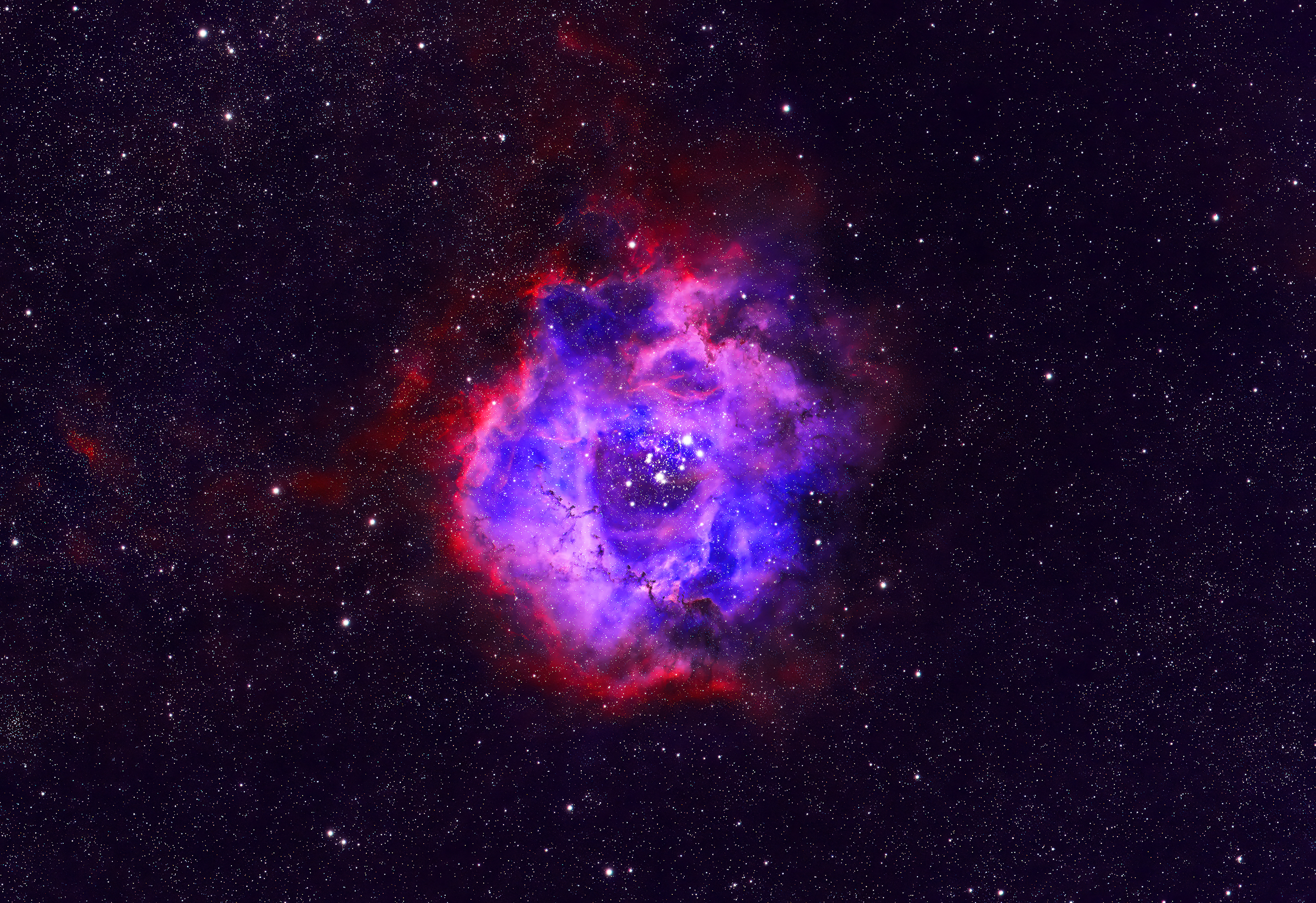
- The Core Zone (O-III)
Closest to the blistering central star, the UV radiation field is incredibly intense and packed with high-energy, short-wavelength photons. This is the only region hot enough to create and sustain O2+ ions. Consequently, O-III emissions are almost always concentrated in a tight core directly surrounding the stellar source.
In the Core Zone, hydrogen and sulphur are present, but they are overwhelmed by high-energy ultraviolet radiation: Hydrogen is completely stripped of its single electron eV threshold. Because the radiation field is so fierce, the hydrogen stays continuously ionized H+ and cannot recombine fast enough to emit the characteristic H-alpha visible light; Sulphur is easily stripped past its first ionization stage and the core’s extreme energy drives sulphur into much higher ionization states (like S2+ or S3+), meaning it cannot produce the SII emission line in this zone.
- The Middle Shroud (H-α)
As starlight travels outward through the gas cloud, the most energetic photons are absorbed by the oxygen atoms. The radiation field becomes “softer” or depleted of its highest energies. However, there is still plenty of light above the 13.6 eV threshold, creating a massive, sprawling middle zone where hydrogen is continuously ionized and recombined. As this zone still contains plenty of energy above 10.4eV, the sulphur atoms mixed into this layer remain over-ionized into higher states, keeping the SII signature suppressed.
- The Outer Shock Fronts (S-II)
At the cold, distant edges of the nebula, the radiation has been heavily filtered. It lacks the power to split hydrogen or double-ionize oxygen. Yet, the remaining low-energy photons can still ionize sulphur (10.4 eV). Additionally, these outer edges are where the expanding nebula crashes into the cold interstellar medium. These violent collisions create supernova remnants and shock fronts that mechanically heat the gas, exciting the sulphur atoms and causing S-II to glow brightly at the physical boundaries of the cloud.