

Astro Thoughts: Cosmic Nurseries and the Biological Ledger — Mapping Evolution to the Stars
In 1973, the evolutionary biologist Theodosius Dobzhansky wrote: “Nothing in biology makes sense except in the light of evolution.”
Dobzhansky’s central argument was that without the unifying framework of evolutionary pressure, biology dissolves into disjointed random facts. Evolution acts as the beam that binds genetics, anatomy, and ecology into a predictable biological science.
As astrophotographers, our relationship with data is fundamentally transactional, mapping the structures of deep space-time onto monochrome silicon sensors. Yet, when we step back from the technical reduction algorithms, we discover a profound cross-disciplinary mirror.
When reflecting on the mechanics of evolution, the process can be described through three pillars:
- all species show inherent variation;
- specific environmental alignment drives adaptation; and,
- this alignment secures reproductive longevity over generations.
This framework summarizes Charles Darwin’s core mechanism of natural selection. By examining how these three Darwinian pillars govern the natural world, we can trace a direct visual and physical analogue to images of deep-sky targets: the cosmic and biological ledgers share the same evolutionary rules.
1. Inherent Variation: The Structural Continuum of the California Nebula
Darwin’s theory notes that variation is not a collection of anomalous “mistakes” or accidental deviations from an ideal, static template. Instead, variation is a normal, inherent, and a vital part of biology. Without variation, natural selection has nothing to choose from; the evolutionary engine stalls.
This requirement for raw, structural diversity finds its celestial mirror in the sprawling gas sheets of the California Nebula (NGC 1499).

NGC 1499 is an example of an extensive, fluid ecosystem of ionized gas. Unlike compact, highly structured planetary nebulae, the emission cloud is characterized by a lack of uniform composition. Throughout its light-years-long drift, density variations are everywhere. Hydrogen atoms exist in a state of varying compression, density, and temperature.
Just as Dobzhansky demonstrated that wild fruit fly (Drosophila) populations maintain a vast pool of hidden genetic diversity to endure environmental shifts, the California Nebula relies on this baseline variation. These unevenly distributed pockets of matter ensure that when the energetic radiation from the nearby star Menkib sweeps across the cloud, the nebula does not react uniformly. The localized variations dictate which regions glow with intense energy and which remain dark, providing the raw, volatile material needed to kickstart cosmic structural evolution.
2. Environmental Alignment: The Selective Filtering of the Trifid Nebula
The second pillar of Darwin’s work dictates that a trait’s value is never absolute; it is entirely dependent on the specific environment. As the environment acts as a physical filter, traits that align tightly with local pressures thrive, while unaligned variations fade.
We find a striking visual representation of this selective filtering within the complex, partitioned architecture of the Trifid Nebula (M20).
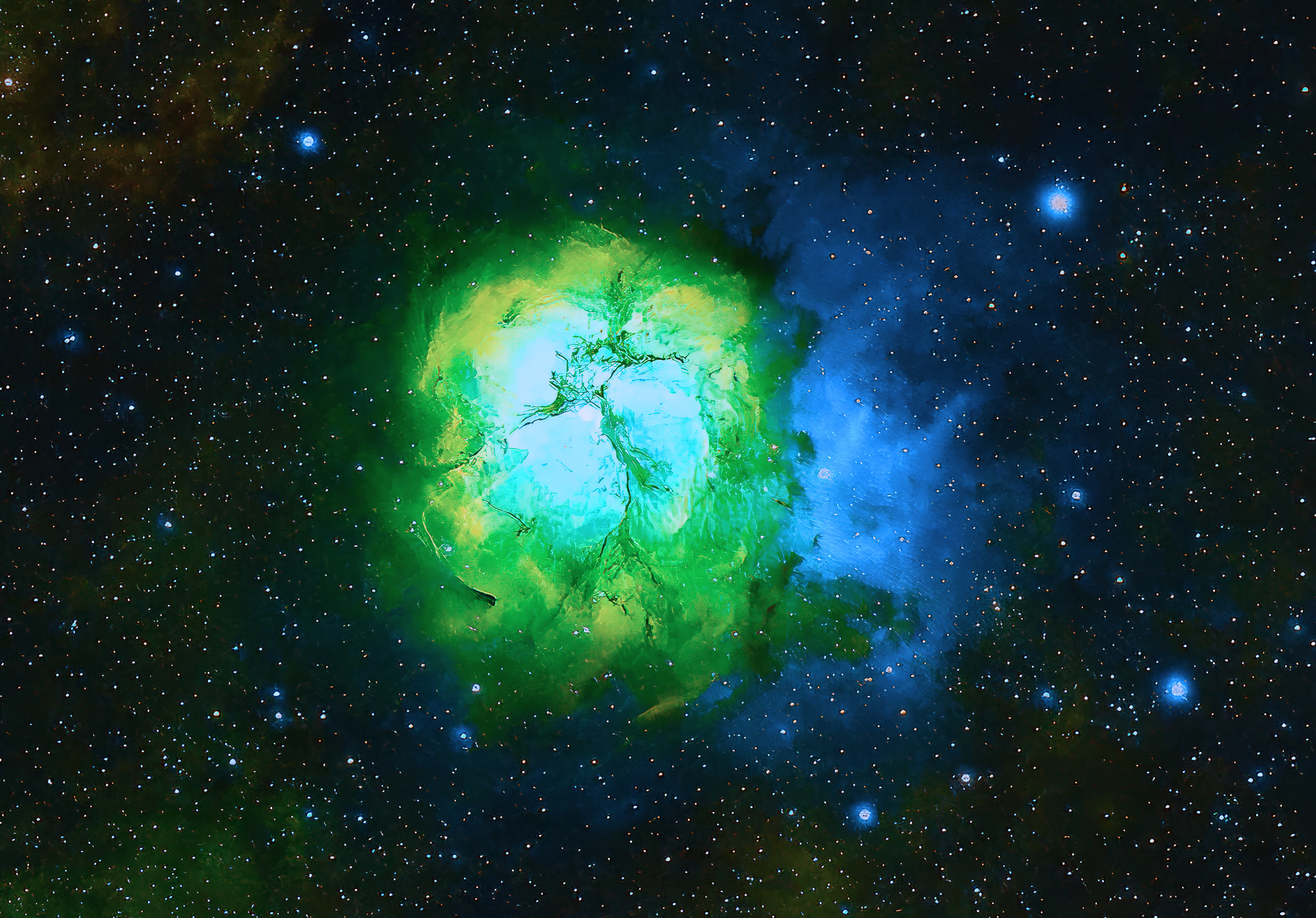
As captured in the Pareidolia Collection, the Trifid Nebula is a chaotic interstellar environment split into a dynamic ecosystem of three distinct lobes bisected by opaque dust lanes. At its geometric centre, powerful, newly born stars flood the surrounding space with ultraviolet radiation and high-velocity particle winds.
This radiation field behaves like Darwinian natural selection: it serves as an environmental filter. Pockets of diffuse gas that cannot withstand the high-energy photon bombardment are rapidly evaporated and sheared away, dissolving back into the background void. Only the densest, most structurally resilient dust nodes—such as the dark lanes compressing near the nebula’s core—possess the alignment necessary to endure the stellar onslaught. The environment filters the cosmic noise, selectively carving the nebula’s shape and consolidating the matter that will eventually survive to form stellar systems.
3. Generational Longevity: The Induced Star Synthesis of the Whirlpool Galaxy
The third pillar from Darwin’s work involves passing advantageous traits to subsequent generations, shifting the genetic makeup of a population over time through differential reproductive success. This is where external environmental interactions catalyse systemic adaptation, ensuring long-term generational survival.
To visualize this macro-scale structural induction and generational continuity, we can transition to the elegant, winding spirals of the Whirlpool Galaxy (M51).

M51’s tightly sculpted arms are not static fixtures; rather, they are dynamic star-formation factories. The architecture of these arms is maintained and re-energized by its close gravitational interaction with the passing companion dwarf galaxy, NGC 5195.
As NGC 5195 glides past, its gravitational muscle pumps rhythmic density waves through the Whirlpool’s pancake-shaped disk, like ripples in a pond. When these tidal waves pass through orbiting interstellar gas clouds, they squeeze and compress the hydrogen molecules along the inner edges of the arms.
This compression triggers a widespread collapse of material, leaving behind a wake of star birth seen as bright pink star-forming regions and clusters of hot, blue newborn stars. The old cosmic dust is continually repurposed to build next-generation stars. Just as environmental selective pressures ensure that advantageous biological variations shift the genetic makeup of a population across generations, the tidal interaction within the Whirlpool system pushes legacy gas into high-energy starburst states—securing the structural longevity and creative evolution of the galaxy across billions of years.
Conclusion: Balancing the Cosmic Ledger
Whether examining the molecular unity of DNA through a microscope or tracking the starburst filaments of colliding galaxies through a telescope, the underlying rules of creation remain similar. Isolated components find their meaning only when bound to a unifying core architecture.
Biology becomes a coherent science only when viewed in the light of evolution. Similarly, astrophotography images cease to be random collections of coloured pixels when we understand the structural selection rules behind them. They are the visual, empirical records of a universe engaged in continuous variation, adaptation, and evolutionary synthesis. By merging the biological insights of Dobzhansky and Darwin with the lesser-travelled views of the deep sky, we find that the cosmic and biological ledgers seem balanced—and we are thus staring into the mirror of a universe evolving to see itself.