
In astrophotography, data is often treated as an unyielding truth. Software suites like PixInsight train us to treat raw, linear photon counts with scientific respect. Yet, the moment we map these quantum arrivals into a colour matrix to create a visual image, a tension arises: Where does the rigid science of the pixel end, and where does artistic interpretation begin?
Purists within the community might argue for an unmediated, strictly linear approach to processing, warning that complex masking, multi-exposure hybrid blending, or transitioning data into external creative suites corrupts the empirical reality of the cosmos.
But this critique overlooks a fundamental truth of astrophysics and data visualization: the universe itself is not a static linear exposure. To capture the complex chemistry of deep space, one must look past the limits of a single global stretch. By examining the chemistry and geometry of the Pencil Nebula (NGC 2736) – one can reconsider the “pure pixel” and consider why hybrid processing can be an architectural necessity.
The Science: Ionization and Kinetic Shock Fronts
Located 815 light-years away within the Vela Supernova Remnant, the Pencil Nebula is a sharp, luminous filament. It is not a standard diffuse emission nebula sculpted by stellar winds. Instead, it is a localized cosmic shock front—a fragment of an ancient stellar explosion’s blast wave ploughing through space at over 180 kilometres per second.
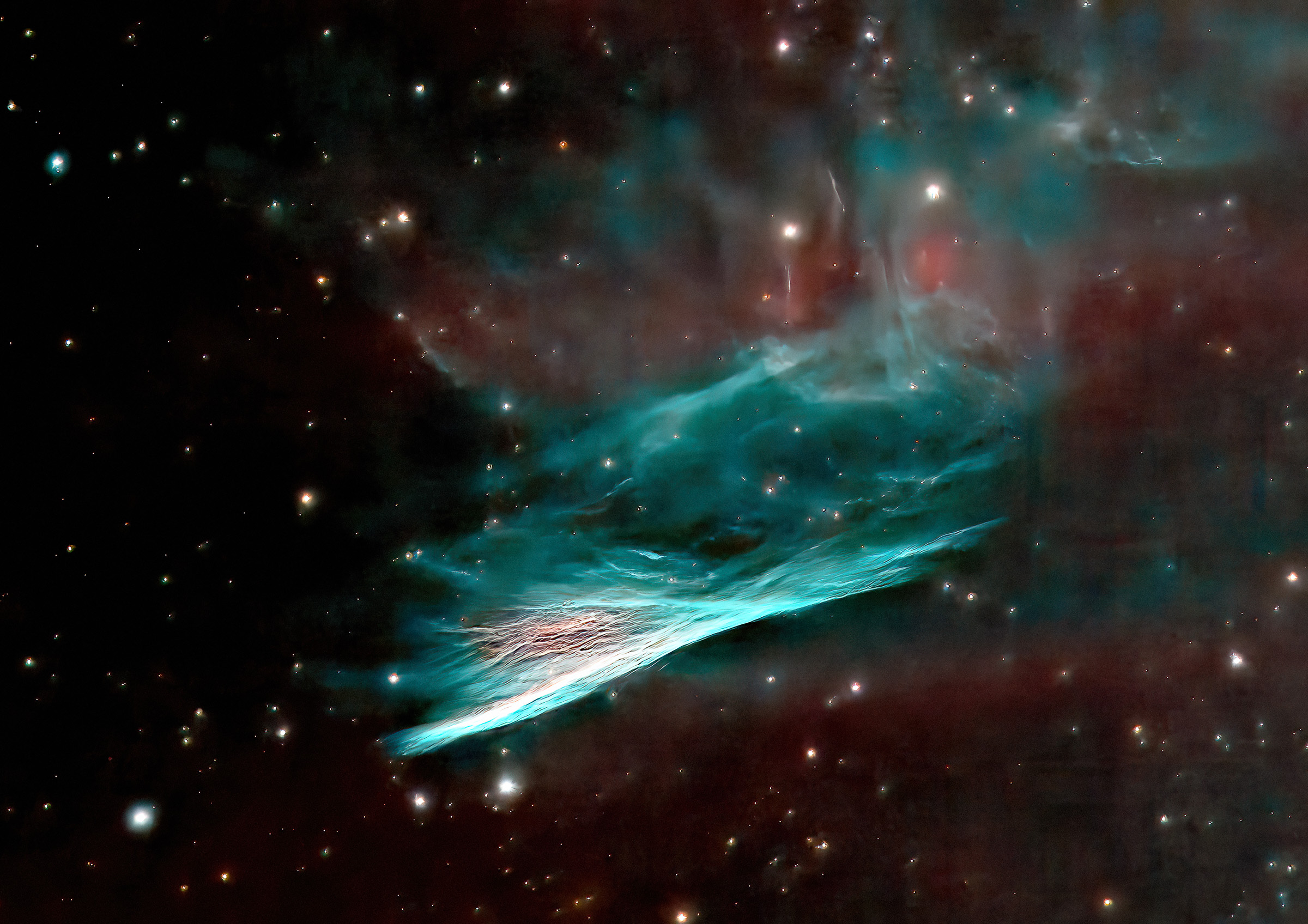
As this high-velocity shock wave slams into cold, dense pockets of interstellar gas, kinetic energy converts into thermal and quantum energy. The gas atoms are stripped of their electrons, ionized, and as they cool back down, they release photons at highly specific wavelengths.
The visual structure of NGC 2736 is an intricate, undulating sheet of light seen edge-on. In the above image, complex chemistry resolves into a stratified, multi-layered canvas:
- The Leading Edge (Bright White/Cyan Ridge): Where the shock front first collides with interstellar matter at maximum velocity, compressing the gas and causing all channels to combine into a brilliant, high-intensity white-hot core.
- The Trailing Wake (Vibrant Teal Billows): Highly excited, glowing gases expanding into space, captured through the narrow band of doubly ionized Oxygen ([OIII]).
- The Background Canvas (Diffuse Crimson/Magenta): The sweeping, cold gaseous sheets of Hydrogen-alpha (Ha) that frame the edge of the blast zone against the void.
The Technology: The Limits of Global Linear Data
A purist’s approach dictates that a single, mathematically uniform global stretch across the linear data provides the most “honest” representation of this shock front. But when applied to a target like the Pencil Nebula, strict mathematical uniformity fails the physics.
The braided filaments of NGC 2736 possess a large discrepancy in brightness and structural scale. The razor-thin primary shock rim glows with high intensity, while the trailing, woven sheets of gas diffuse rapidly into the absolute blackness of the surrounding cosmic void.
If you apply a conservative global stretch to protect the sharp, delicate boundaries of the primary white-hot ionization front, the expansive, faint teal trailing sheets and the moody red background dust remain buried in the background noise. Conversely, if you apply an aggressive, global histogram transformation to reveal those faint, undulating background structures, the sharp leading edge saturates, bloats, and loses its internal structural definition.
Treating the data with uniform mathematical parameters across the entire frame does not preserve reality; it hides it behind the limits of our screens.
The Art: Hybrid Processing and Cultural Pareidolia
To resolve this, a workflow can step away from a single linear process and adopt a parallel, hybrid architectural approach. By utilizing advanced, non-linear processes in PixInsight—such as Generalized Hyperbolic Stretch (GHS)—the data is split into independent structural tracks. One track isolates and preserves the high-contrast highlights of the primary white ridge, while a parallel track aggressively uncoils the deep, faint midtones of the trailing teal gas filaments.
The final reassembly of these tracks happens via localized masking and layer blending within creative environments like Photoshop. To the purist, jumping from the scientifically rigid environment of PixInsight into a layer-based creative suite can be considered as introducing “signal noise” and subjective interpretation.
However, the architecture of the Pencil Nebula itself vindicates the hybrid approach. The delicate threads of ionized gas are not isolated, autonomous structures: They derive their velocity, excitation states, and cosmic brightness directly from their integration with the primary expanding supernova blast wave. By using localized masking to blend a conservatively stretched core with aggressively pushed outer filaments, one is structurally mimicking the physical reality of the target.
Furthermore, this intersection of art and technology is precisely what triggers cognitive connections. When one isolates the hyper-velocity filament of glowing gas against the dark void, our brains don’t just see a spreadsheet of photon counts. As explored in The Cosmic Architecture of Pareidolia, our neural machinery projects familiar narratives onto the image.
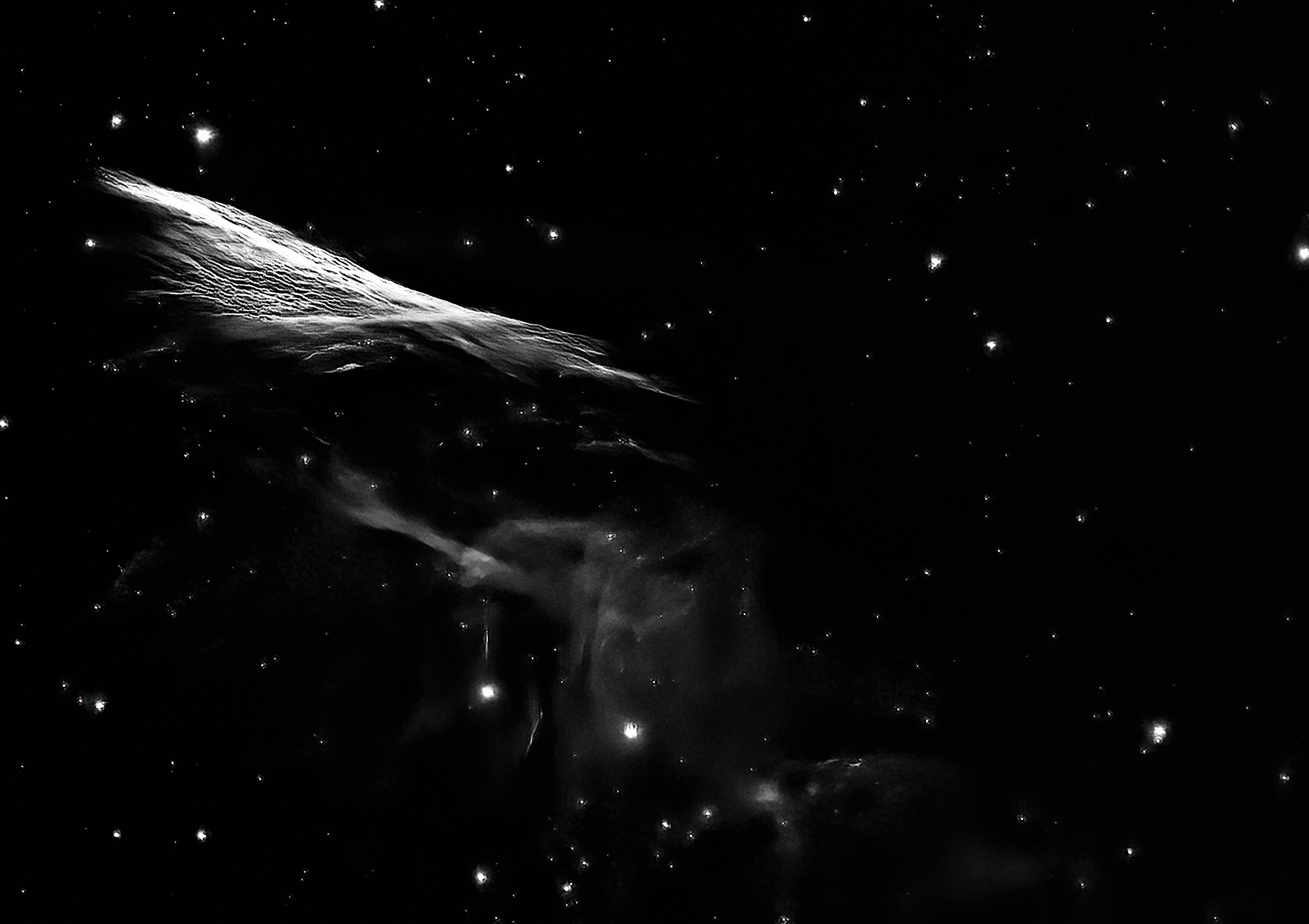
In a monochrome presentation, this slender, hyper-velocity filament looks, to my mind, a little like a legendary Star Trek vessel—resembling the Voyager or the Enterprise—streaking at warp speeds across the interstellar medium. This is not a distortion of data; it is the validation of it. Our technological tools allow us to resolve the finely-combed, brushstroke-like micro-filaments of the leading edge cleanly so that the brain can seamlessly map human imagination onto the deep-space velocity of a real supernova shockwave.
Conclusion: Balancing the Cosmic Ledger
Astrophotographic work will always trigger debate when platform paradigms shift or processing workflows evolve. True data integrity does not mean leaving pixels untouched or trapped within flat, unreadable linear constraints. Rather, it means treating the raw photon counts with scientific respect during the foundational reduction phase, and then using different technological tools to translate those quantum arrivals into a coherent, visible structural reality.
The cosmos is a dynamic system of phase shifts, energetic boundaries, and continuous transitions. Like the universe itself, processing techniques can evolve past historic limitations. In the long timeline of astrophotography, the concrete, visible result—an image that reveals both the violent, razor-sharp front of a supernova blast wave and the faint, ghostly remnants trailing in its warp-speed wake—is what ultimately outlasts transient academic noise.
By blending Art, Science, and Technology, one does not distort the night sky; rather its true architectural depth is illuminated.