
The Cosmic Odyssey: Mapping Homer’s Epic to the Deep Sky.....
For ten years, Homer’s Odysseus navigated a treacherous sea, thwarted by vengeful gods and goddesses, ensnared by autonomous sorceresses, and hunted by monsters before finally reaching his home in Ithaca.
For those of you who have read Emily Wilson’s English translation of the Odyssey (or other translations), or watched Christopher Nolan’s film , The Odyssey, you will know that The Odyssey is an epic about nostos (homecoming), the restoration of order, and what it means to rebuild an identity after the trauma of war. However, this homecoming is not merely a male soldier’s physical journey; it is equally defined by Penelope’s internal battle to protect her household in Ithaca. While The Iliad focuses on achieving glory through physical death, The Odyssey prioritizes survival, focusing on (at least) two people who must use metis (cunning and strategic wit) to endure a twenty-year separation.
Penelope is the thematic anchor of the narrative, embodying the exact same intellectual heroism as Odysseus. Trapped in her own home by the violent suitors who “devour a great man’s house”, she relies on deception to stall her remarriage. As she later explains to a disguised Odysseus, “I waste my heart instead in longing for Odysseus… They urge me to wed, and I weave a web of deceit”. For three years, she famously tricks the suitors by weaving a shroud by day and unravelling it by night, admitting, “Three whole years I deceived them blind, seduced them with this scheme”.
Her role also centres heavily on the restoration of xenia (hospitality) and social order. While her son, Telemachus, rails that “your heart was always harder than a rock” when she hesitates to immediately embrace Odysseus upon his return, her caution is actually the ultimate demonstration of her critical mind. By testing him with the secret of their immovable bridal bed, she ensures that the man reclaiming her kingdom is her true partner, not an impostor. Ultimately, The Odyssey proves that homecoming is a collaborative act of survival; Odysseus can only return because Penelope successfully defended the world he left behind.
As astrophotographers, we undergo our own odysseys under the stars, facing the dark void to capture a glimpse of something ancient and beautiful. The night sky is a cosmic canvas where these mythic struggles are still written. Below is one example of an astronomical roadmap of Odysseus’s journey home, pairing the challenges of The Odyssey with deep sky objects (DSOs) captured by astroanderson.com across the Northern and Southern hemispheres.
- Athena’s Wisdom & The Shield of Protection
- The Cosmic Match: The Wizard Nebula (NGC 7380)
- The Narrative: The goddess Athena acts as Odysseus’s divine protector, guiding his steps with sharp strategy and cloaking him in defensive mists to evade enemies. In the northern sky, the celestial sorcerer of the Wizard Nebula appears to cast a protective cosmic spell across space.
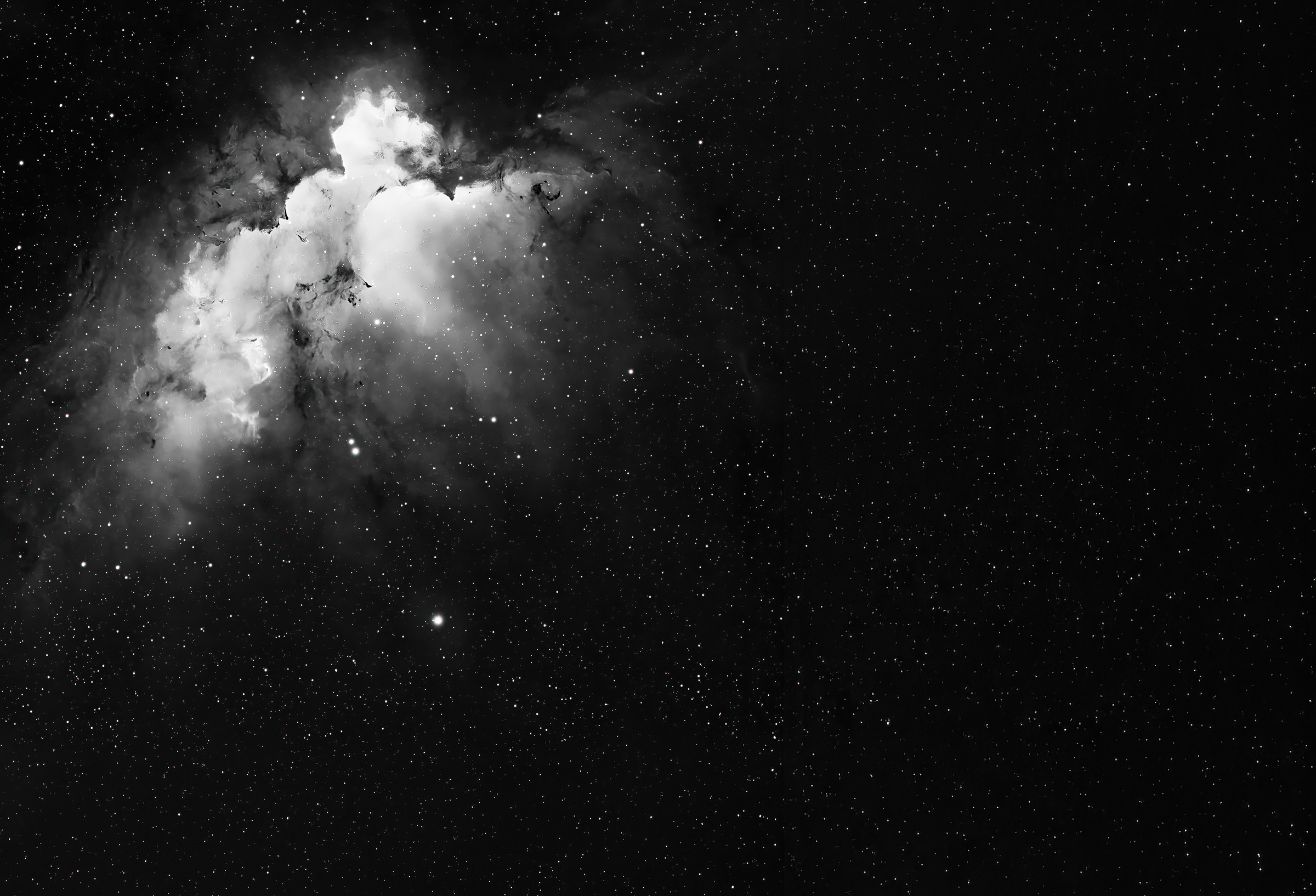
The Wizard Nebula (NGC 7380), Capturing Divine Protection: This integration highlights the faint, enveloping structures of gas that mirror Athena’s protective mist, emphasizing how reason and structure can be carved out of deep cosmic chaos.
- The Philosophical Dimension: Athena represents the dawn of human reason, strategic foresight, and self-possession. Her protection is not a ‘get-out-of-jail-free card’, but rather the internal spark of human intellect working in harmony with fate. The Wizard Nebula visualizes this invisible shield of logic and consciousness guarding a fragile human soul against the overwhelming, chaotic forces of an untamed universe.
- The Wrath of Poseidon & The Celestial Seas
- The Cosmic Match: The Lobster Nebula (NGC 6357)
- The Narrative: Poseidon, God of the Sea, is Odysseus’s primary antagonist, churning up violent storms and commanding predatory deep-sea wildlife to rip the hero’s fleet apart. Deep in the southern heart of Scorpius, the fierce, churning dust clouds and glowing gas structures of the Lobster Nebula bring this volatile marine kingdom to life.
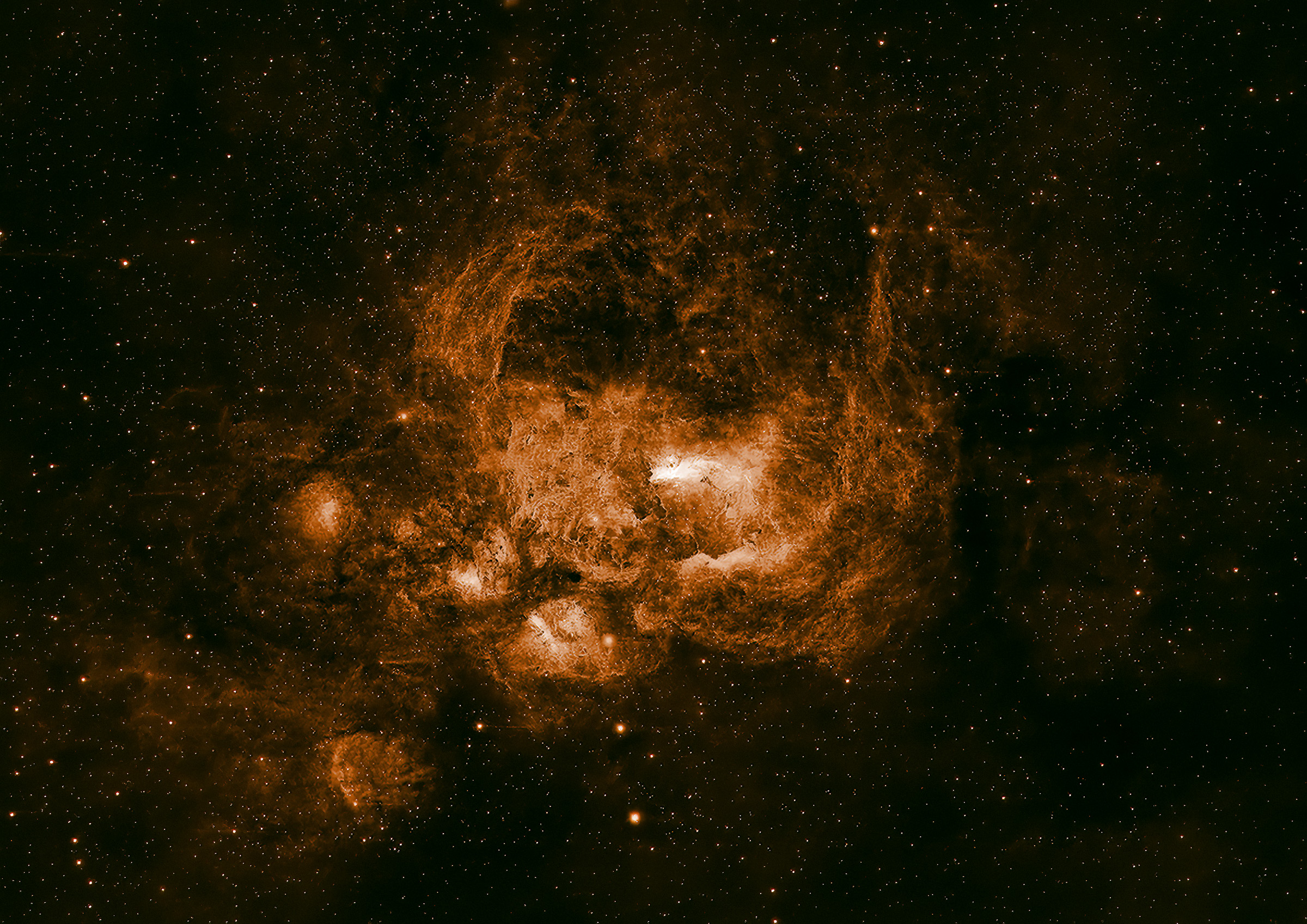
The Lobster Nebula (NGC 6357), Sailing the Violent Depths: This volatile Southern hemisphere target captures the aggressive, wind-blown ionization fronts surrounding the open cluster Pismis 24, bringing out the turbulent, wave-like rifts in the hydrogen gas, evoking the unyielding fury of Poseidon’s oceans.
- The Philosophical Dimension: Poseidon represents the untamed ego, raw subconscious rage, and the merciless indifference of nature. When Odysseus arrogant-mindedly brags to the world, he triggers Poseidon’s wrath. The Lobster Nebula—with its violent, energy-spewing stellar winds—symbolizes the crushing emotional and environmental storms that baseline reality hurls at us when we let our unchecked hubris override our humility.
- Calypso’s Isolated Paradise
- The Cosmic Match: The Carina Nebula (NGC 3372)
- The Connection: The sovereign nymph Calypso holds Odysseus captive on her remote island of Ogygia, offering him literal immortality if he stays. The breathtaking, sprawling beauty of the Carina Nebula—anchored deep in the Southern hemisphere—perfectly represents this exotic, completely isolated island paradise cut off from the rest of the known universe.
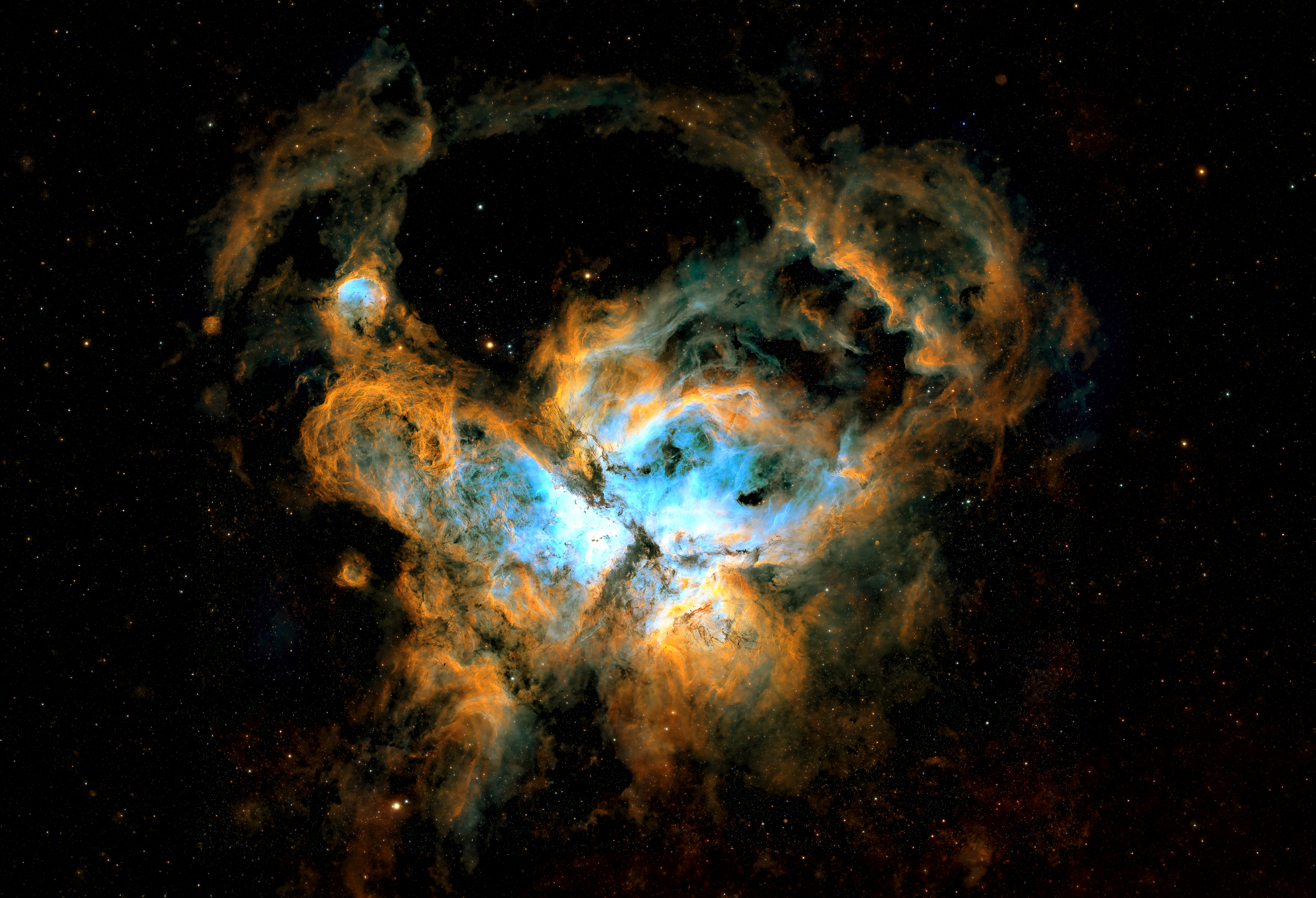
The Carina Nebula (NGC 3372), The Gilded Cage of Ogygia: Its overwhelming scale and dust lanes that represent Calypso’s beautiful evolutionary trap.
- The Philosophical Dimension: Calypso’s island is the philosophical trap of stagnation, comfort, and existential erasure. To accept her offer of immortality is to step out of time, which means giving up the struggle, suffering, and relationships that make a human life meaningful. The immense, glittering dust pillars of the Carina Nebula embody this gilded cage—a beautiful cosmic dead-end where a soul can easily lose its drive to achieve its true purpose.
- Circe’s Metamorphic Magic
- The Cosmic Match: The Flaming Star Nebula (IC 405)
- The Connection: On the island of Aeaea, the powerful goddess and master of herbology Circe asserts her authority by subverting humanity, transforming Odysseus’s rowdy crew into beasts. The unique structure of the Flaming Star Nebula, featuring dark, shifting, smoke-like filaments wrapping around the star AE Aurigae, perfectly mirrors the vaporous hearths of Circe’s island where she weaves her transformative magic.
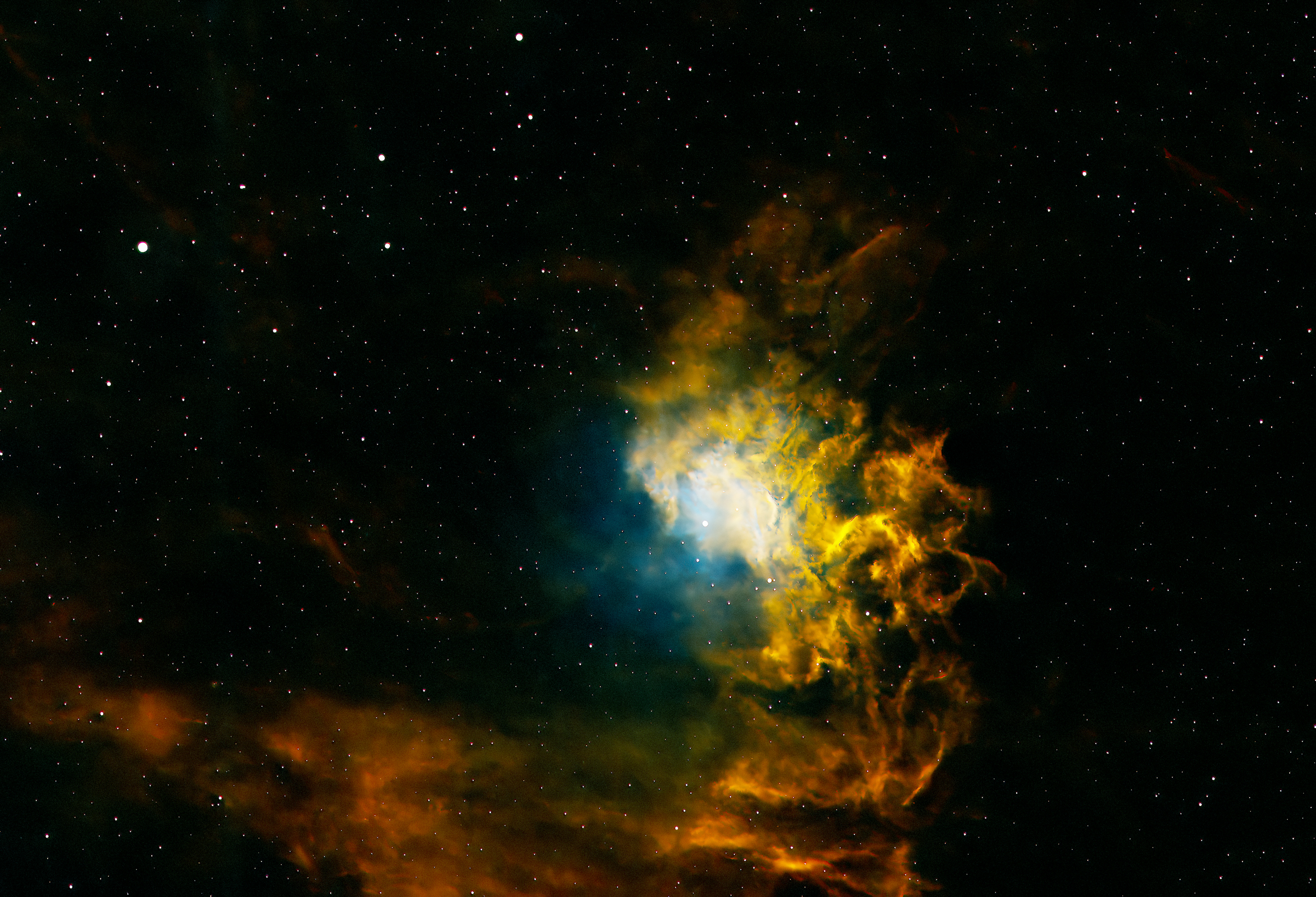
IC 405 (The Flaming Star Nebula), The Fog of Aeaea: The cosmic smoke-like filaments swirling around the star AE Aurigae perfectly capture the deceptive, shifting nature of Circe’s island, mapping a boundary where matter seemingly morphs out of thin air.
- The Philosophical Dimension: Circe’s magic does not actually change human nature; it merely peels away the fragile layer of social politeness to expose the base, primal animalism lurking within. She forces us to confront our inner beast. The smoke-like filaments of the Flaming Star Nebula capture this beautifully, acting as a cosmic fog that reflects our own hidden shadows and uncultivated primal impulses.
- The Blinded Cyclops, Polyphemus
- The Cosmic Match: The Lagoon Nebula (M8)
- The Connection: Odysseus famously outsmarts and blinds the one-eyed giant Polyphemus, a son of Poseidon, by calling himself “Nobody.” Piercing through the heart of Sagittarius, the bright core and deep, dark dust lanes of the Lagoon Nebula resemble a massive, glowing singular eye staring out into the void.
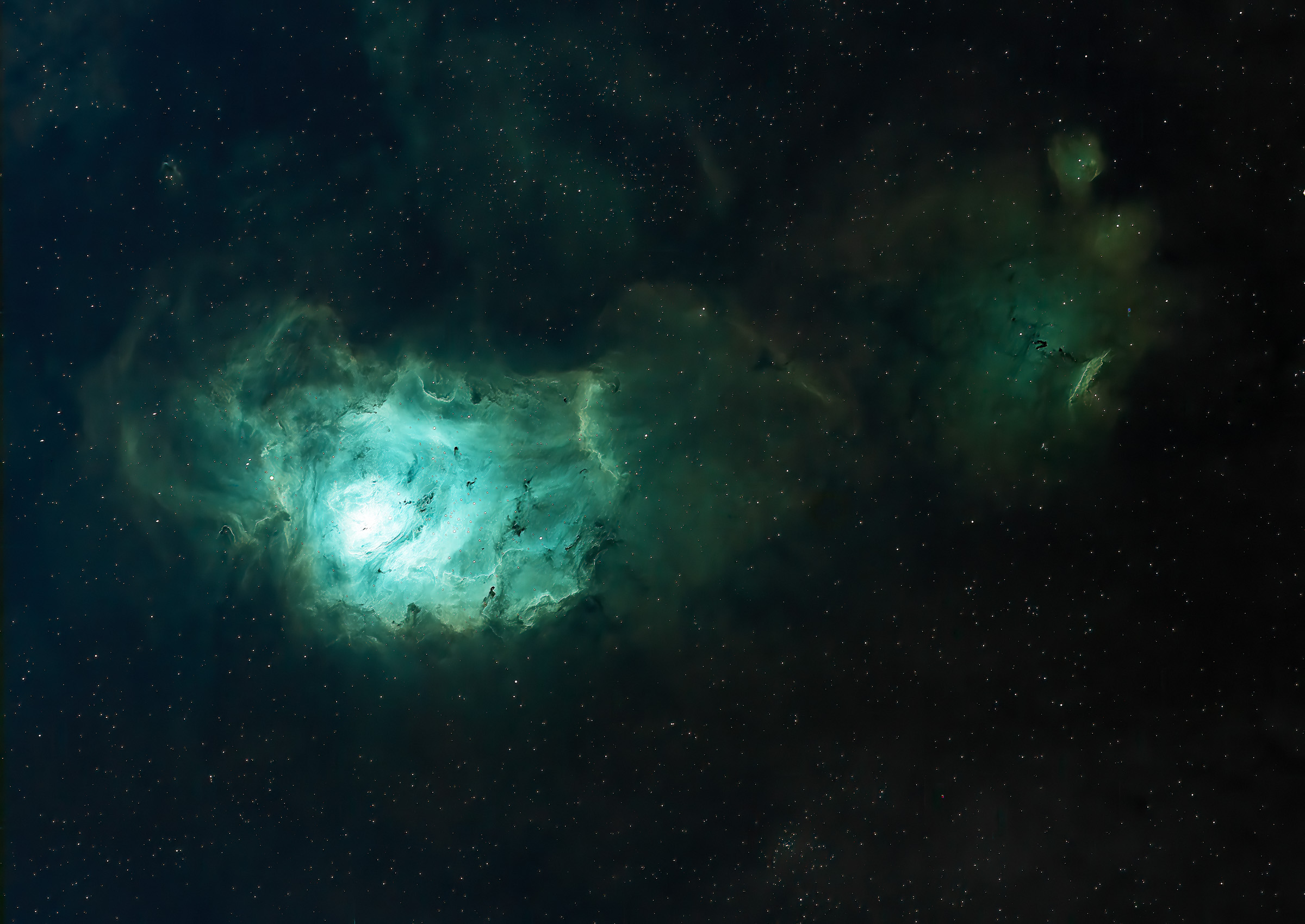
The Lagoon Nebula (M8), Piercing the Singular Eye: Contrasting the brilliant star-forming core against the cold, opaque dust clouds showcases the stark contrast between blind, unreasoning cosmic energy and structured void.
- The Philosophical Dimension: Polyphemus represents the danger of literalism, brute force, and a narrow, singular worldview. He lacks empathy, hospitality, and a broader vision of society. By calling himself “Nobody,” Odysseus uses abstract thought to defeat muscle. The dark lane slashing through the centre of the Lagoon Nebula serves as a monument to this moment—the violent shattering of blind, unreasoning tribalism by the power of flexible intellect.
- The Sirens’ Deadly Song
- The Cosmic Match: The Seagull Nebula (IC 2177)
- The Connection: Creatures who lure passing sailors to their deaths on rocky shores with their irresistible, hypnotic singing. Straddling the celestial equator, the sweeping, wing-like structures of the Seagull Nebula evoke the avian, half-bird nature of Homer’s original Sirens, singing across the cosmic void.
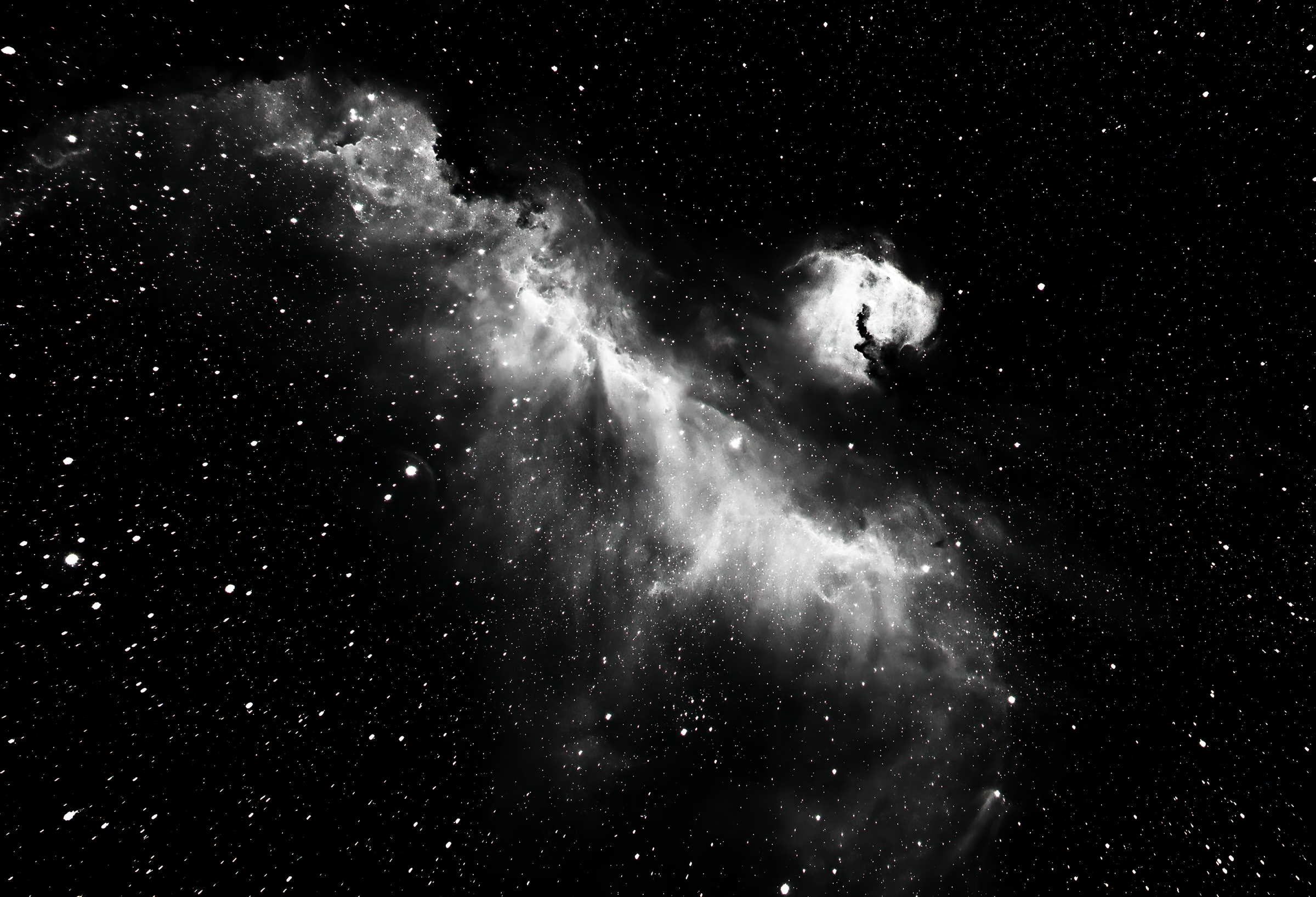
The Seagull Nebula (IC 2177), The Hypnotic Span: Straddling the celestial equator, the vast, isolating space surrounding the nebula, visually mimicks the irresistible, solitary siren song echoing across the ocean desert.
- The Philosophical Dimension: The Sirens do not lure men with simple lust, but with the seductive promise of total knowledge—they claim to know everything that ever happened on the fertile earth. They offer a paralyzing obsession with the past that prevents any future action. The wide, soaring expanse of the Seagull Nebula represents this treacherous allure: the intoxicating temptation to look back and drown in nostalgia or past glory instead of moving forward.
- Caught Between Scylla and Charybdis
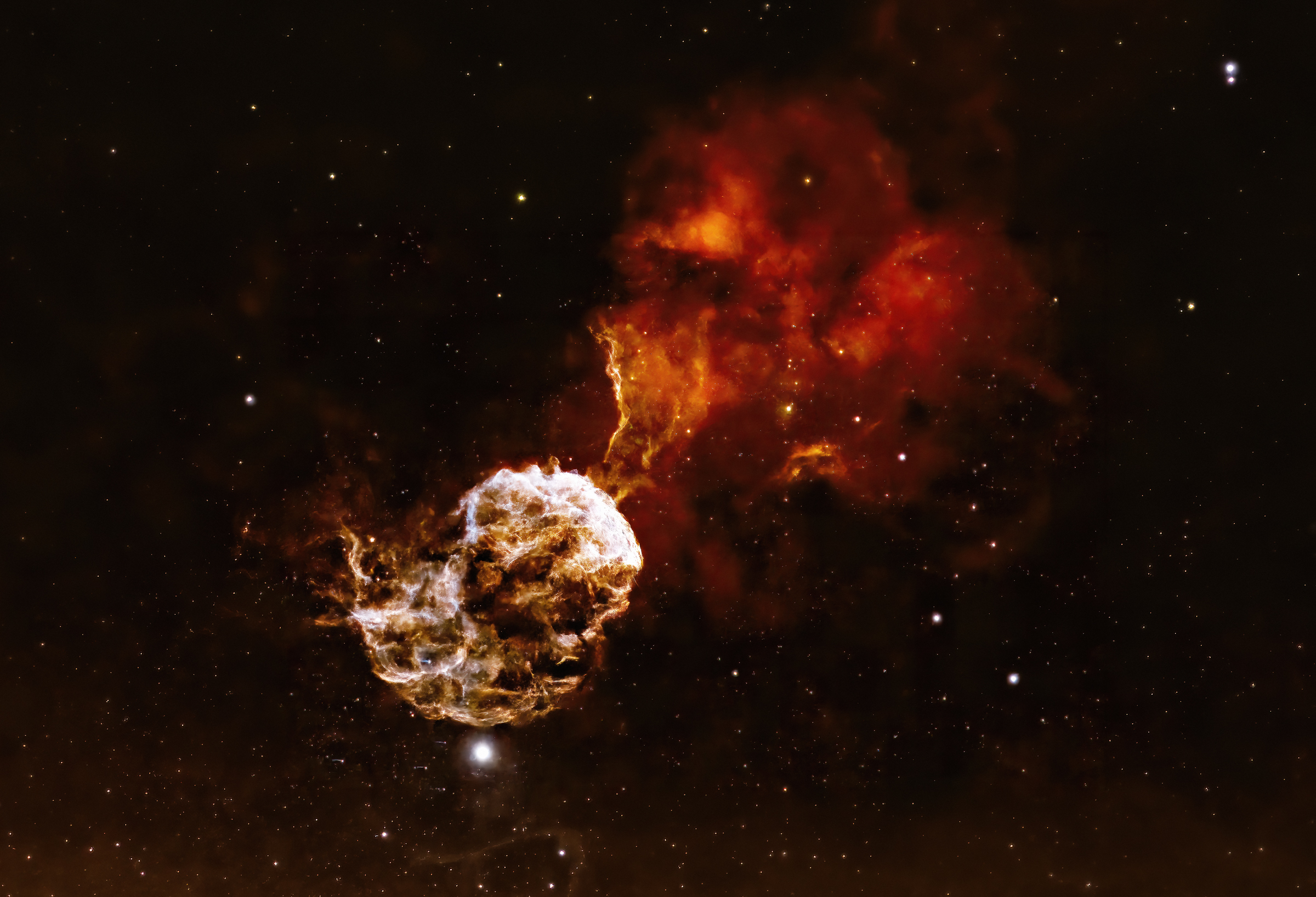
- The Cosmic Match: The Whirlpool Galaxy (M51) & The Jellyfish Nebula (IC 443)
- The Connection: Odysseus must navigate a narrow strait, squeezed tightly between a ship-swallowing whirlpool and a multi-headed cliff monster. Charybdis is perfectly mirrored by the grand-design spiral arms of the Whirlpool Galaxy, while Scylla’s snapping, chaotic heads are captured by the trailing, tangled gaseous filaments of the Jellyfish Nebula.
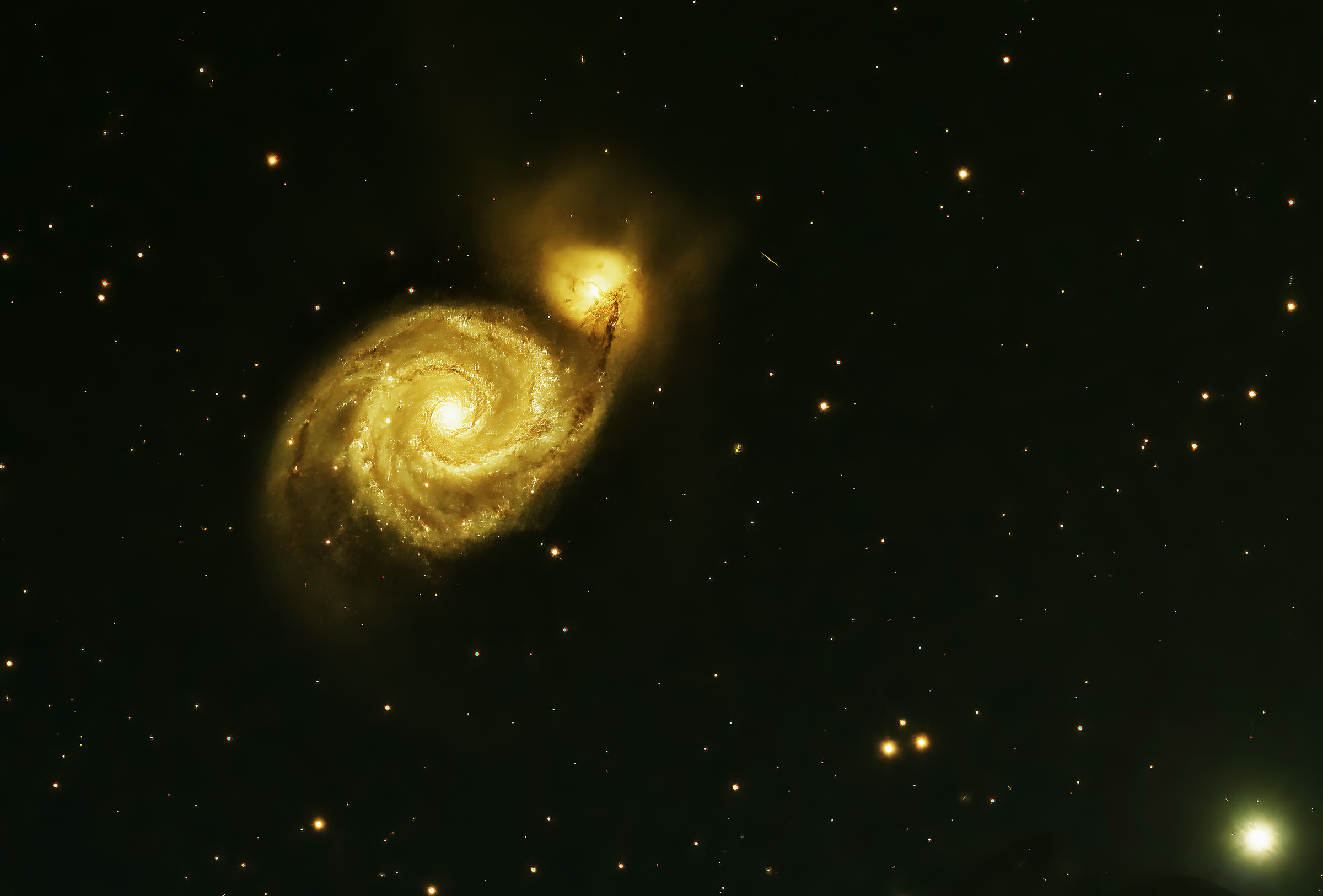
The Whirlpool Galaxy (M51)
The Jellyfish Nebula (IC 443)
The Narrow Strait of Extinction: deep gravitational tides pull the companion galaxy toward the main spiral core of M51; the supernova remnant of IC 443 demonstrates delicate, frayed filaments of exploding gas. Together, their contrasting styles illustrate the tight squeeze between a gravitational vortex and sharp, acute destruction.
- The Philosophical Dimension: This is the ultimate ethical dilemma: choosing between total annihilation (the whirlpool of Charybdis) or a calculated, tragic loss of a few crew members (the monster Scylla). It is a lesson in the harsh realities of leadership and compromise. The pairing of M51’s gravity well and IC 443’s chaotic, frayed supernova remnants represents the psychological friction of being caught between total systemic collapse and acute, painful trauma.
- The Cattle of Helios (The Sun God)
- The Cosmic Match: Solar Prominences
- The Connection: Stranded by storms, Odysseus’s starving men disobey orders and slaughter the sacred, golden cattle of the Sun God, Helios. Solar Prominences captured on the dynamic surface of our own sun represent the literal, fiery fury of Helios punishing the crew for their sacrilege.
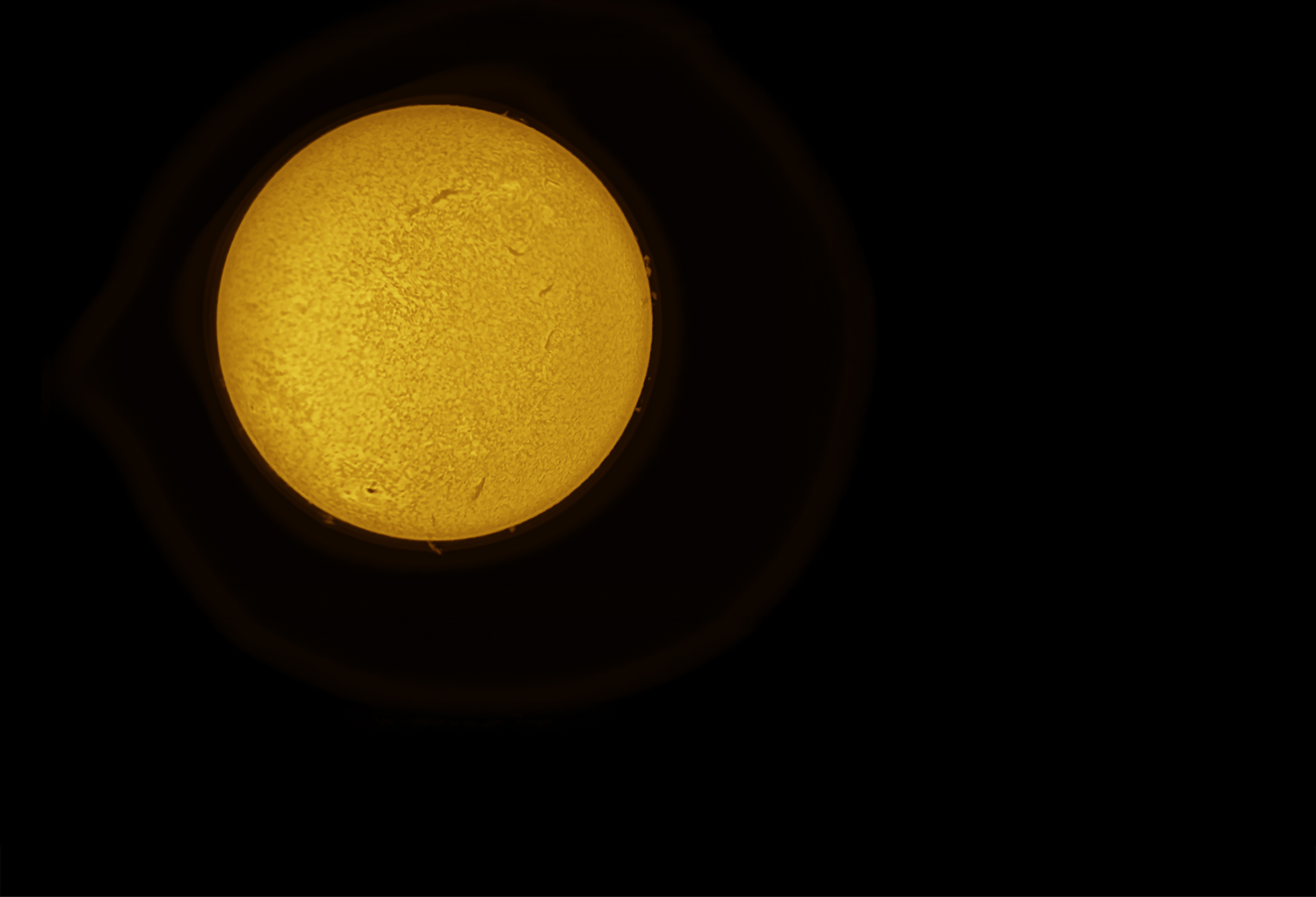
Solar Prominences, The Unforgiving Flame: Using a dedicated H-alpha solar telescope, one can see on the edge of the sun fast-moving, looping magnetic eruptions, capturing the terrifying, real-time kinetic energy of Helios’s anger, where physical matter is instantly torn apart by solar winds.
- The Philosophical Dimension: The cattle of Helios symbolize the sacred boundaries of the natural order and the danger of short-sighted, desperate consumption. When the crew eats the cattle, they trade their long-term future for immediate, desperate satisfaction. The explosive, snapping magnetic loops of a Solar Prominence remind us that violating the foundational rules of ecology, morality, or physics brings a swift, self-inflicted cosmic reckoning.
- Arrival in Ithaca and the Bow of Odysseus
- The Cosmic Match: The Orion Nebula (M42) & The Bow Shocks of θ1 Orionis group of stars
- The Connection: Returning home in disguise, Odysseus reclaims his throne by successfully stringing his ancient bow and shooting an arrow through twelve axe-heads. Hanging from the “Belt” of the celestial hunter, the brilliant Orion Nebula sits at the epicentre of raw warrior strength. Notably, this mirrors Book 5 (Lines 273–274) of the poem, where Homer mentions Orion as a vital navigational constellation that Odysseus watches intently to pilot his raft away from Calypso’s island. Deep within this stellar nursery lie the θ1 Orionis group of stars within the Trapezium open cluster, where the energetic winds from young stars collide with the slow-moving nebula gas, forging spectacular, glowing cosmic bow shocks.
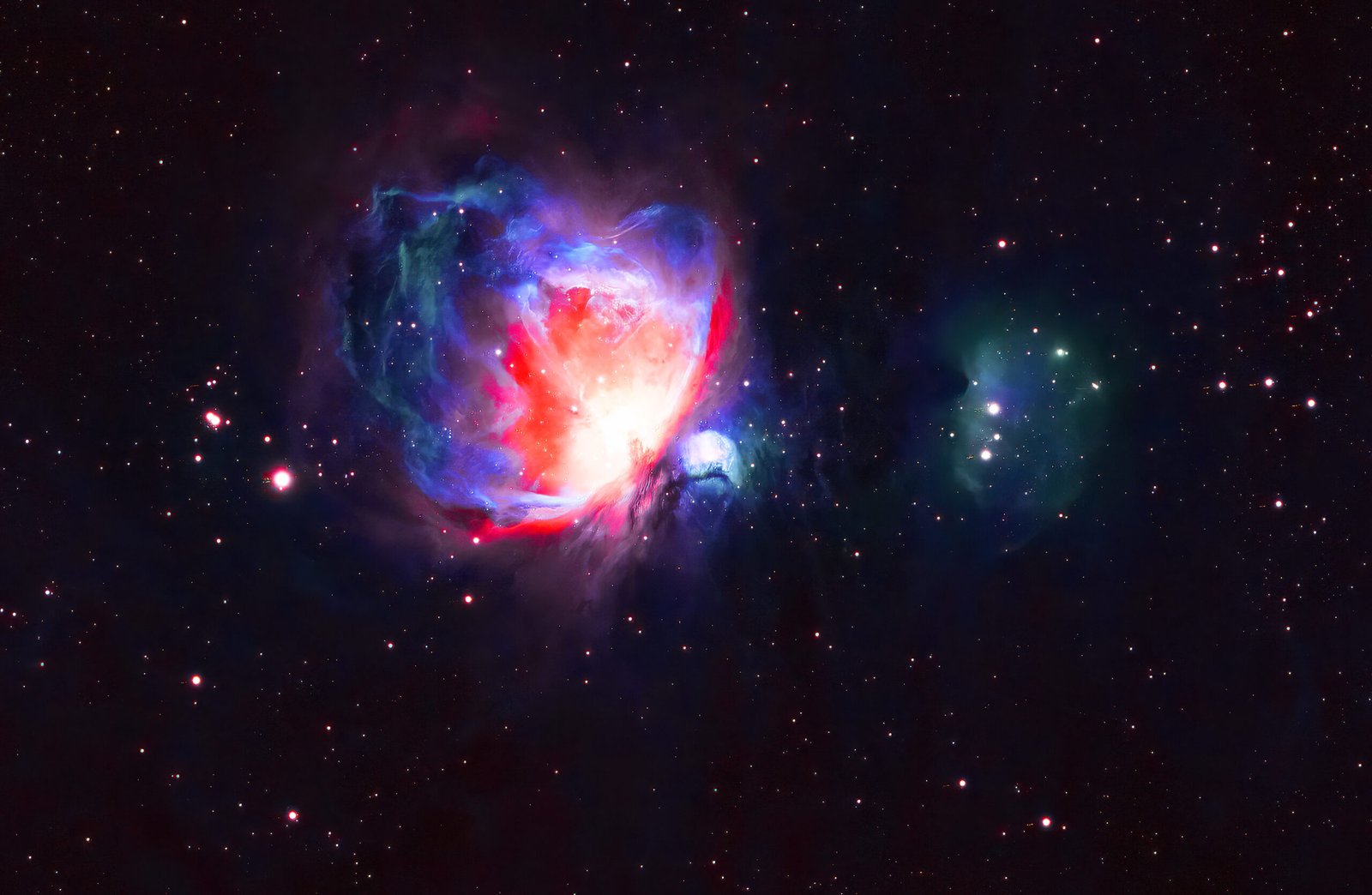
The Orion Nebula (M42), The Navigational Anchor & Drawn Bow: Between the main part of the Orion Nebula and De Mairan’s Nebula (M43), the round object located just to the side of the main body of the Orion Nebula, is, in red, a bow-shaped structure. Although I do not have the technical equipment to capture them, deep within the nebula, energetic winds from the θ1 Orionis group of stars collide with the slow-moving nebula gas, forging spectacular, glowing cosmic bow shocks.
- The Philosophical Dimension: Stringing the bow is an act of alignment—it requires a perfect combination of physical strength, technical skill, and psychological focus. It signifies the restoration of balance and justice after years of domestic chaos. The violent, beautiful collision of forces creating the Orionis bow shocks perfectly visualize this moment: they are the literal, drawn bows of the King, where immense kinetic pressure and focused energy are held in perfect, tense equilibrium just before the arrows of justice are unleashed to reclaim a kingdom.
- Penelope: The Architectural Intellect and Cosmic Loom
- The Cosmic Match: The Veil Nebula (NGC 6960 / NGC 6992)
- The Connection: Often flattened by traditional history into a passive, weeping wife, Queen Penelope is actually the true intellectual anchor of Ithaca and a master political strategist. To protect her kingdom from over a hundred aggressive suitors, she executes a brilliant act of silent subversion: she promises to choose a husband only when she finishes weaving a burial shroud, spending her days at the loom and secretly dismantling her own work under the cover of night.
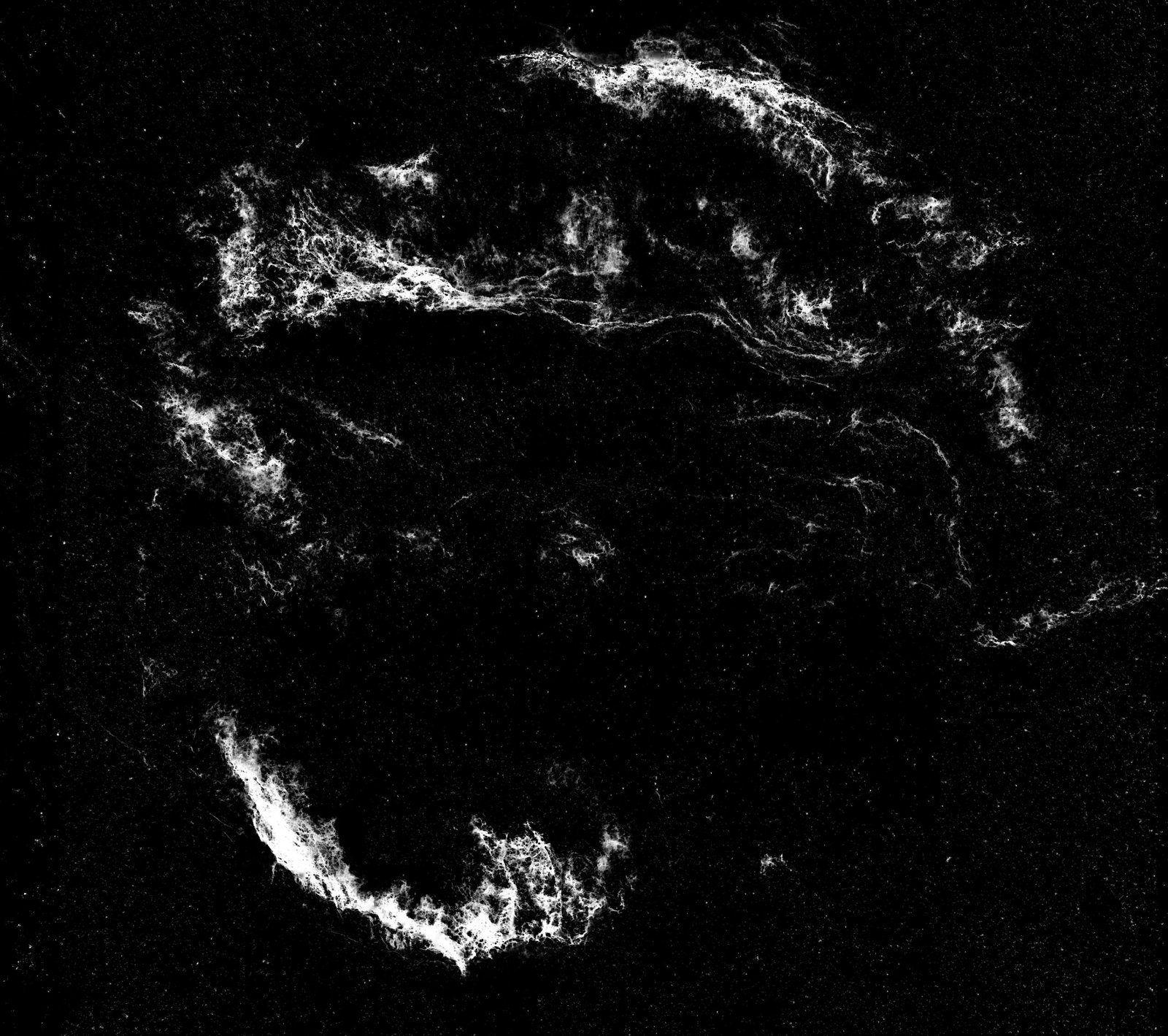
The Veil Nebula (NGC 6960 / NGC 6992), The Unravelling Tapestry: Preserving the fine, hair-like textures of the shockwaves, the Nebula looks remarkably fluid, showcasing the cosmic loom of Penelope as a sharp, meticulously woven net of light defying the darkness of the surrounding vacuum.
- The Philosophical Dimension: Penelope’s loom is a masterclass in feminist subversion, showing how marginalized agency can use domestic labour as a weapon of systemic political resistance. She actively manipulates time itself to deny her oppressors their victory. The intricate, interlacing gas threads of the sweeping Veil Nebula look exactly like a magnificent, shimmering cosmic tapestry caught in mid-weave—a testament to her unyielding mind, weaving and un-weaving the fabric of power to hold a broken world together through pure, patient intellect.
Conclusion: The Deep Sky as Living History
Homer’s Odyssey endures because it mirrors our own fragile mortal existence. It reminds us that whether we are navigating wine-dark seas or tracking photon paths across light-years of empty space, we are all ultimately seeking a sense of home, identity, and structural alignment.
When we photograph the cosmos, we are doing more than collecting astronomical data. We are gathering the remnants of ancient stellar cataclysms—supernova shockwaves, cosmic dust lanes, and solar storms—and transforming them into narratives. The brilliant details we capture, down to the turbulent stellar winds of the Lobster Nebula or the delicate, subversive threads of the Veil Nebula, prove that the night sky is not a cold, unfeeling void. It is a living vault where humanity’s deepest philosophical battles, triumphs, and stories continue across eternity.