
The Lens: Translating the invisible universe into meaning, art, and light through the Pillars of Creation.....
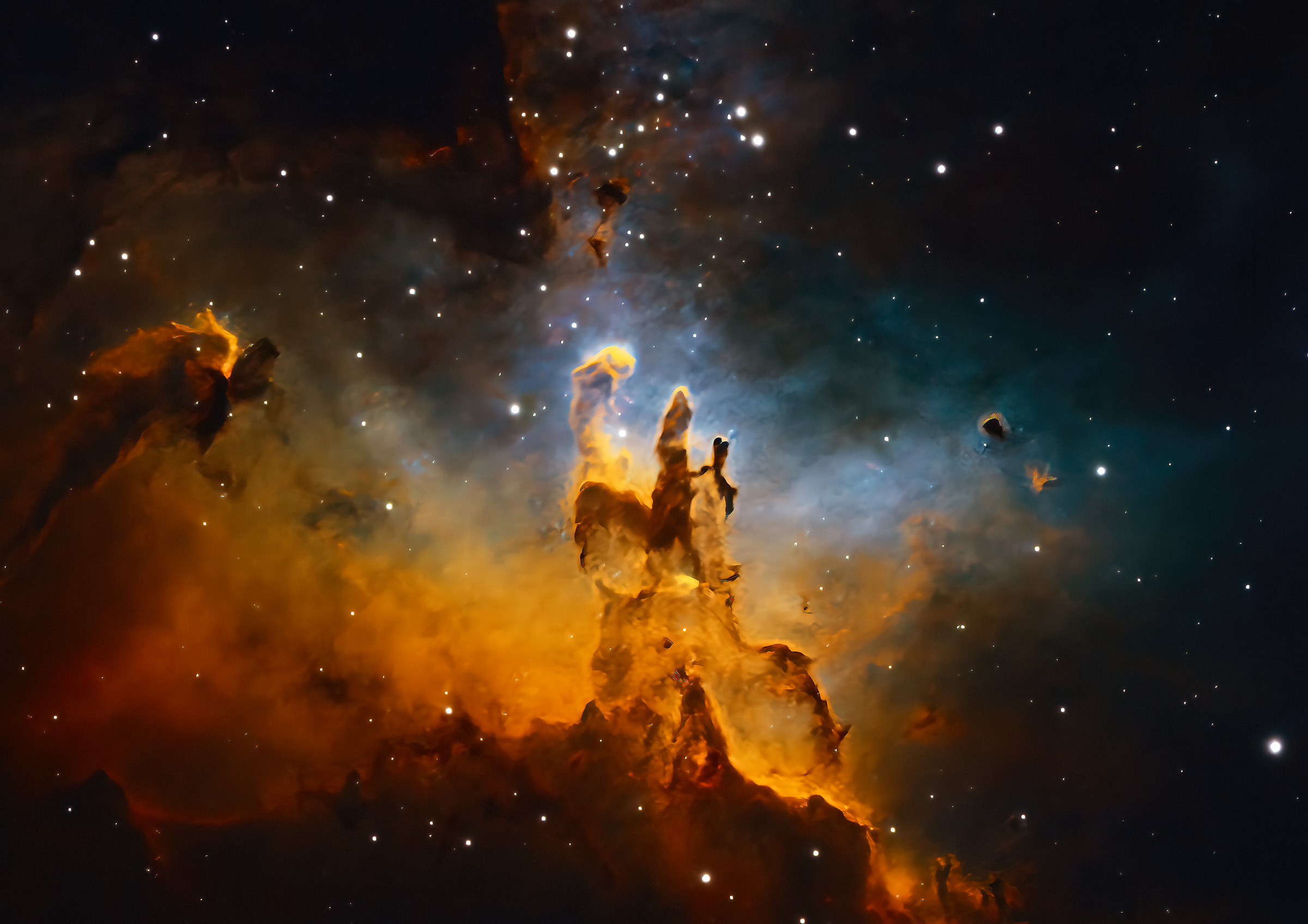
Taking and processing of images of celestial objects is a blend of technology, science and art, here seen within the frame of the Pillars of Creation (inside the Eagle Nebula, M16).
Technology: Shifting the Human Perspective
Our human eyes cannot naturally see the Pillars of Creation – even if we were closer to them, we would only see a dim, mostly colourless smudge. Our eyes lack the exposure-integration time of the cameras that we use, and we cannot natively resolve the faint light of the Pillars.
Overcoming our limitations, technology acts as an extension of human consciousness, allowing us to perceive a reality that exists largely outside of our human sensory system, translating those parts of the universe that we cannot easily see into something we can comprehend.
Science: The Paradox of Non-Existence
From a scientific standpoint, the Pillars of Creation are a volatile stellar nursery—a place where dense interstellar gas and dust collapse under gravity to birth new stars. Yet, they present a profound cosmic paradox.
The Illusion of Time and Spacetime
The Pillars are located roughly 6,500 to 7,000 light-years away from Earth. Because space and time are inextricably bound into a single fabric, spacetime, distance is fundamentally an anchor to the past. What exists out there right now in the present moment is light-years ahead of the visual information currently hitting our eyes. When we image them, we are capturing a phantom. We are looking at a past that no longer exists in the present. Therefore, when we image the Pillars, we are not merely capturing an object in space; we are mapping specific (and beautiful) coordinates in spacetime. Further, as the light travels towards Earth, it does not just travel through space; it travels through space that is actively expanding: thus its wavelengths are stretched en route.
Art: Palettes of Meaning
Capturing light emitted by specific ionized gases: When we use Hydrogen-alpha (H-alpha), Sulphur (SII), and Oxygen (OIII) narrowband filters in our imaging, we are capturing the light emitted by specific ionized gases inside the Pillars. We map these lights using a deeply artistic, subjective choice known as false-colour mapping, assigning the light from ionized Hydrogen, Sulphur, and Oxygen to varying combinations of red, green, and blue.
Creating Truth from Light: The iconic green, gold, and turquoise hues of the Pillars (see Hubble’s view of the Pillars of Creation or, however we chose to represent them) are not “what they looks like”; they are an artistic interpretation designed to reveal chemical structures, using strong contrasts between light and dark to give physical weight, form, and emotional resonance to what is essentially formless, floating gas.