
How cosmic giants sculpt, ignite, and dissolve their gas-cloud cradles.....
Diffuse emission nebulae are massive, structurally fluid clouds of ionized gas that serve as the primary stellar nurseries of the universe. Unlike planetary nebulae or supernova remnants, which represent the structural death throes of individual stars, diffuse emission nebulae are sprawling, irregularly shaped complexes spanning tens to hundreds of light-years across. They are born from giant molecular clouds, driven to glow by the very stars they create, and ultimately torn apart by the family of stars they nurture.
The Life Cycle of a Diffuse Nebula
1. Formation: Cosmic Gravitational Collapse
Every diffuse emission nebula begins its life in complete darkness.
Interstellar Medium: super-cold molecular hydrogen (H2) and helium (He) gases and microscopic cosmic dust (primarily silicates, carbon compounds, iron, and ice mantles, mostly the result of supernovae explosions) drift through galactic spiral arms.
Trigger: a passing galactic density wave, a shockwave from a distant supernova, or basic galactic rotation compresses these cold pockets.
Gravitational Runaway: once a pocket of gas crosses a specific critical mass boundary, its internal thermal pressure can no longer resist gravity: the cloud collapses inward, fracturing into ultra-dense, localized cores.
Real-World Example: the “Caterpillar” Globule (Carina Nebula fine structure), a dense Bok globule represents a pure Stage 1 object. Spanning nearly two light-years across, it is a freezing, opaque nodule of gas and dust. Its ultra-dense core blocks out all background light, marking the calm, dark era immediately preceding the collapse that triggers star birth.

2. Ignition: The Birth of the H II Region
As a fractured core collapses, it converts gravitational potential energy into heat, forming glowing protostars.
O and B Giants: if a protostar accumulates enough mass (typically over 8 to 20 times the mass of our Sun), its core pressure triggers nuclear fusion. It becomes a massive O-type or B-type star.
Photoionization: these newborn giants burn intensely hot and flood the dark cloud with high-energy ultraviolet (UV) radiation.
Transition to Emission: this UV radiation strips electrons away from neutral hydrogen atoms. The resulting sea of plasma, composed of free electrons and naked protons, is scientifically classified as an H II region. When these free electrons recombine with protons, they drop through energy states and emit visible light, causing the diffuse cloud to glow autonomously.
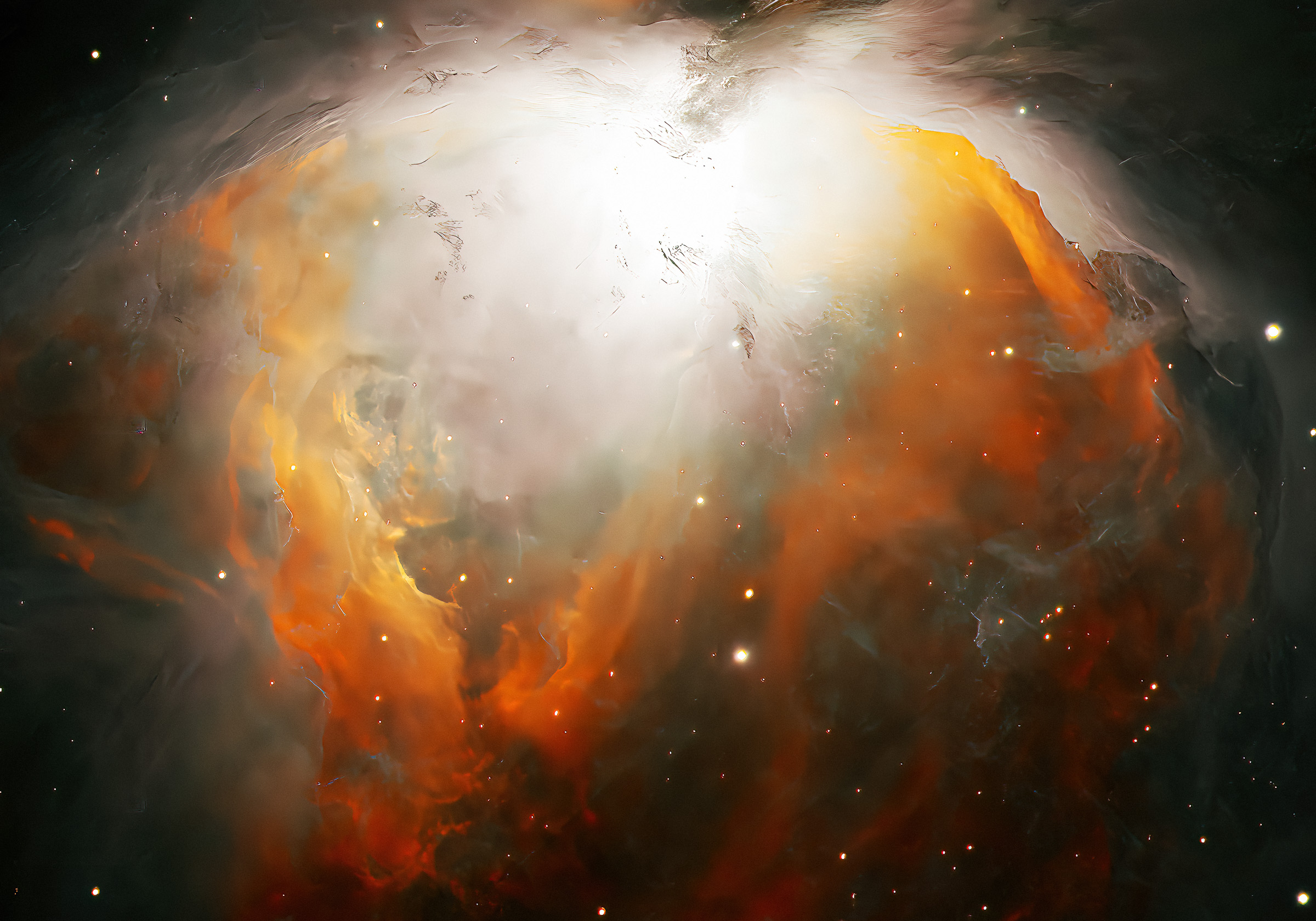
Real-World Example: the Orion Nebula (M42) represents the transition from Stage 2 into early Stage 3. As the closest region of massive star formation to Earth, it is a freshly ignited, highly active H II region.
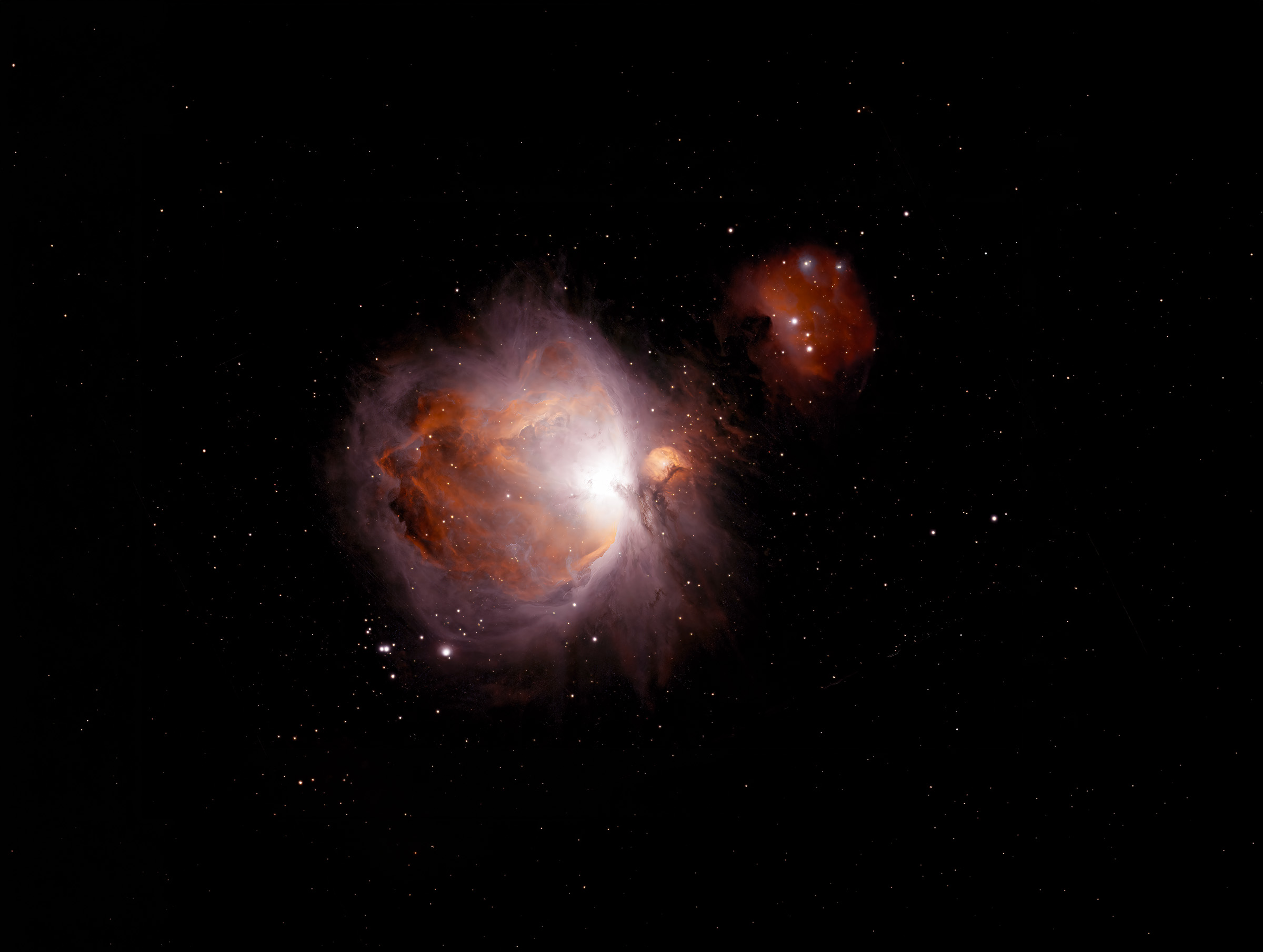
It is powered by the young Trapezium Cluster, which is just beginning to clear out its central stellar cavity while still surrounded by a dense cocoon of star-forming gas.
3. Evolution: The Sculpting Phase
A diffuse emission nebula is a dynamic battlefield between gravity trying to build stars and radiation trying to blow the cloud apart.
Stellar Winds: the central star cluster unleashes fierce streams of charged particles. These winds clear out hollow cavities directly around the stars.
Erosion and Pillars: less dense patches of gas are instantly pushed away. Denser, dust-heavy pockets resist the stellar winds longer, forming elongated, column-like structures pointing directly back at the star cluster.
Triggered Star Formation: the outer edges of these pillars are compressed by shockwaves from the wind, forcing new waves of smaller star birth along the margins.
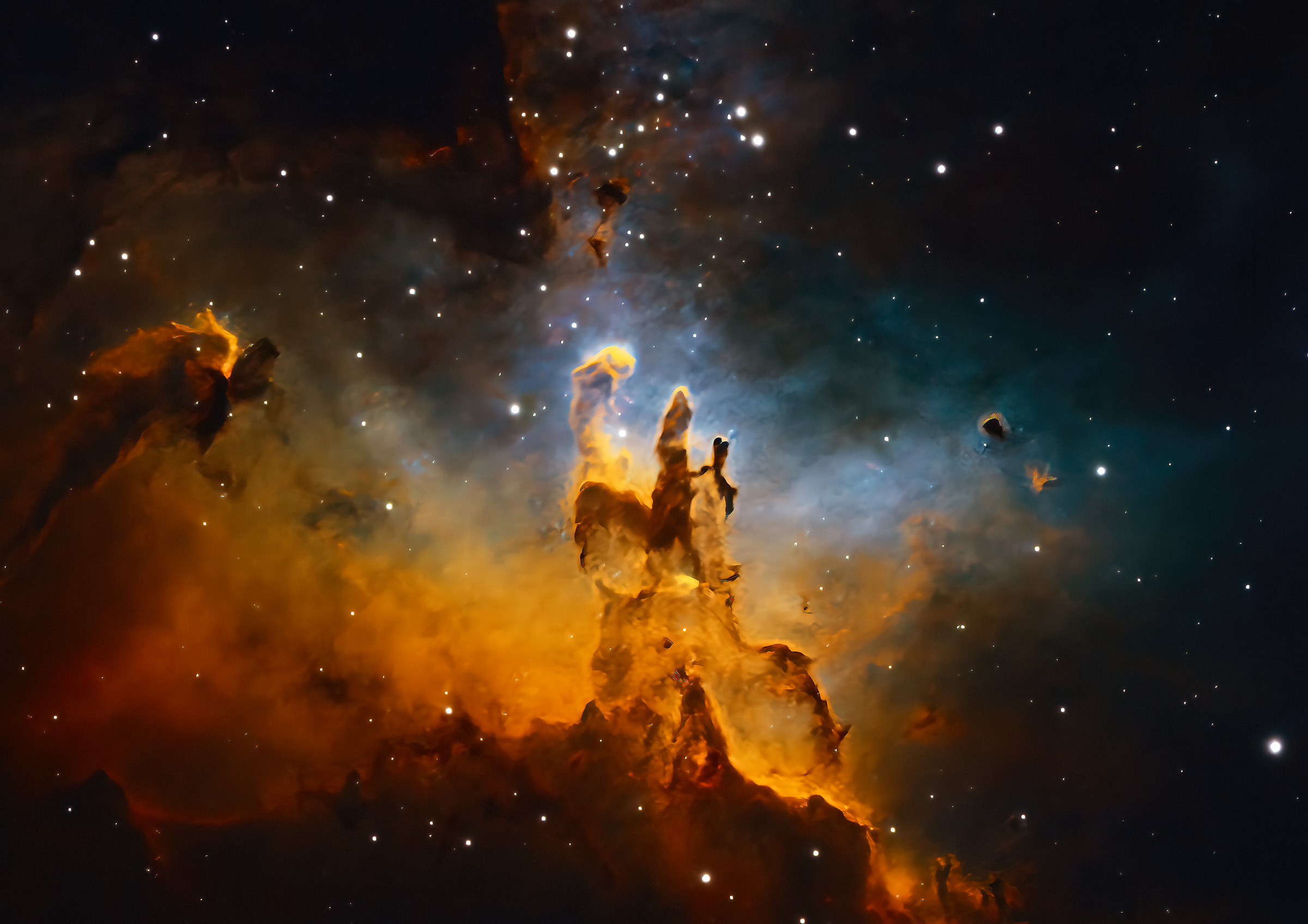
Real-World Example: the Eagle Nebula (M16) is the textbook baseline for Mid-Stage 3. It features the famous “Pillars of Creation,” which perfectly demonstrate the erosion process. Intense radiation from the central open cluster (NGC 6611) is actively carving away the dust columns and exposing embedded, newborn protostars.
4. Death: Dispersion and Recombination
The life of a diffuse emission nebula is brief by cosmic standards, usually lasting only a few tens of millions of years.
The Blowout: radiation pressure and stellar winds accelerate the gas outward until it reaches the cloud’s escape velocity.
The Efficiency Limit: nebulae are highly inefficient star factories, with only about 10% of the total gas mass converted into stars. The remaining 90% is blown out into the interstellar medium.
Real-World Example:
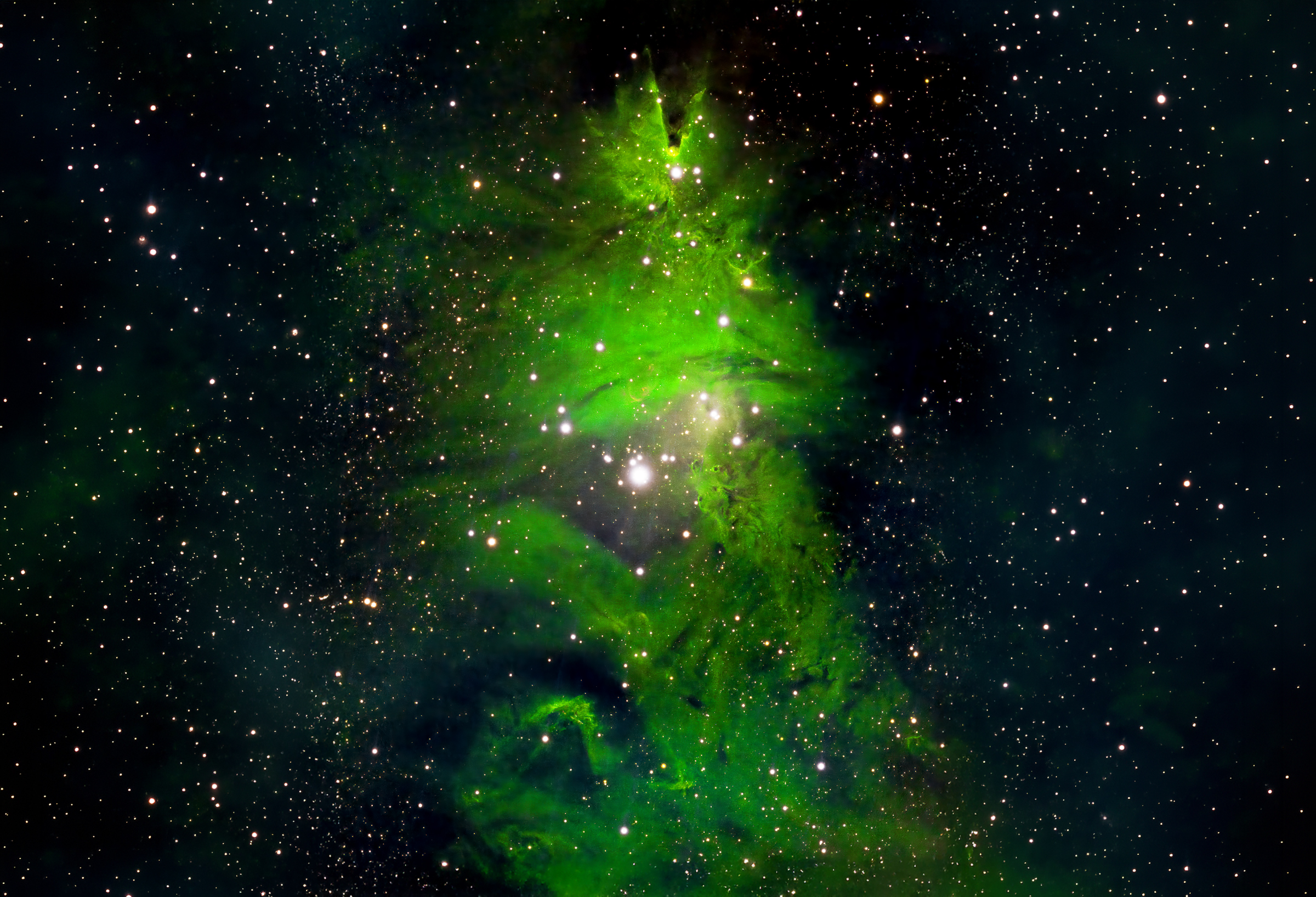
The Christmas Tree Cluster (NGC 2264) serves as a prime example of the transition from late star formation, featuring the massive star S Monocerotis acting as a cosmic snowplough to clear surrounding gas. The adjacent Cone Nebula represents the remaining 90% of the molecular cloud, which is actively being eroded and dispersed by intense stellar winds and UV radiation.
Extinction: once the gas is dispersed and moves too far from its parent star cluster, the UV radiation drops. The plasma cools, the electrons permanently recombine, and the cloud fades back into cold, invisible space. What remains is an open cluster of young stars moving together through the galaxy.