
This is not a question I can answer – everyone must do their own research and come to their own conclusion.
However, if a friend of mine wanted to take up this hobby, I would check out a few things first:
1. Do you have the time, energy and patience to take up this hobby? It is an incredibly rewarding hobby, but it takes up a lot of time and energy. It works for me – although I have a young family to take care of, I am retired from work – in a way, the hobby keeps me going from a scientific and technical point of view. And, you surely need a lot of patience! Things go wrong: Despite the best weather forecast, clear skies cloud over; despite all careful diligence, mistakes get made! Patience and much perseverance are required. Let’s assume, time, energy and patience are there.
2. What do you want to photograph? Deep-sky objects like nebulae, or planetary imaging within the solar system? Different equipment is needed for imaging different objects. Let’s assume nebulae.
3. Have you got a good enough view of the night sky to make it worthwhile? In particular, what’s it like looking towards the east? Is the view free of obstacles such as trees or buildings? Are you in the middle of a city – is there much light pollution? Let’s assume a good-enough view and not too much light pollution.
4. Are you willing to invest a reasonable amount of money? In my view, it is better to go for more expensive and better-quality equipment to start with, rather than work your way up, which ends up being more expensive in the long run. Let’s assume the costs can be managed.
5. Why do you want to take up this hobby – what is your motivation? My motivation was the challenge – the blend of science, technology and art. Also, giving me something to do that is time out of the troubles of the world, and time to reflect and contemplate our responsibility and place in the cosmos. It is a hobby that can be for everyone – whoever you are, wherever you are, and whatever your world view.
I have been fortunate to try out different things over time and in different locations – northern and southern hemispheres (and, soon at the equator, Barbados). Based on my experience, this is what I would say to my friend (if you take on anything of what I say, please accept that this is your responsibility, not mine (!)). Please check here for further information.
For the mount, I have experience of both harmonic drives (e.g., ZWO AM5) and German Equatorial mounts (e.g., Celestron CGEM). They each have their own advantages and disadvantages. I would tell my friend to go for a harmonic drive and would suggest the 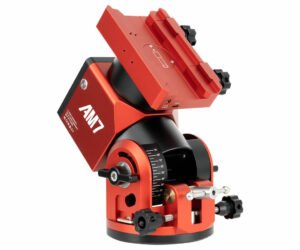 ZWO AM7 Harmonic Equatorial GoTo Mount. To me, harmonic mounts are lighter and much easier to set up and operate than German Equatorial mounts. Although ZWO has cheaper and smaller mounts, the AM7 seems to me a good investment for the future, as it can carry heavy telescopes. I have an AM5, which I find very easy to use and tracks excellently enabling high quality images to be captured. I have just bought the AM7.
For the tripod, I have experience of both a heavy-duty tripod (e.g, Celestron CGEM tripod) and lightweight tripods (e.g., ZWO TC40 Carbon Fibre Tripod). I would advise my friend to go for a heavy-duty tripod rather than a light weight one.  I find the ZWO carbon fibre tripod is not stable enough when mounting heavy telescopes, and I am always concerned that an accident may happen. As a heavy-duty mount, I have just bought the Berleback Planet Tripod. I bought the Berleback plate to mount the AM7, and the Berlebach rubber ends (using the tripod on a tiled surface) to replace the stainless-steel points (for use on grass). With the AM7, the weight of tripod and mount is still manageable to move around and bring inside when needed.
For a telescope, I would advise the  William Optics Redcat 71. I have found this easy to carry, incredibly easy to use, obtaining high quality images, and, with a focal length of 348 mm, it comfortably captures a wide range of relatively large deep-sky objects. I would also suggest getting the DeepSkyDad Flat Panel, as this acts as both a cover and a dew heater for the scope, as well as taking calibration flat frames very easy.
 For guiding, I would suggest as the simplest solution, the
  ZWO Guide scope Mini 30mm (easy to set up and focus), and the ZWO ASI 120MM Mini Mono as guide camera.
For the main imaging camera, I have used both monochrome cameras and one-shot colour cameras. Monochrome cameras have the advantages of higher resolution and superior sensitivity – they gather approximately three times more photons (light signal) than their colour counterparts in the same amount of time. Thus, for the camera, I would advise my friend to go straight for a monochrome camera. I have found the quality of images to be much better with monochrome cameras, using narrowband filters. It is all a bit more effort, but you quickly get used to it, and the rewards are worth every extra cost and time spent. I use the ZWO ASI 2600mm camera,
 with the ZWO five by 2” electronic filter wheel (EFW) and
  ZWO 7nm narrowband filter set. (I also use a dark filter for taking calibration dark frames).

For focusing, I use the ZWO EAF (Electronic Automatic Focuser), which takes all the hassle out of focussing during a night’s imaging.
 Finally, as controller, I would recommend the ZWO ASIAIR PLUS, as it does everything for a night’s imaging for you. It is very easy to set up and works seamlessly with all equipment. I connect it to my home network, either directly with ethernet cabling, or via Wi-Fi mesh system.